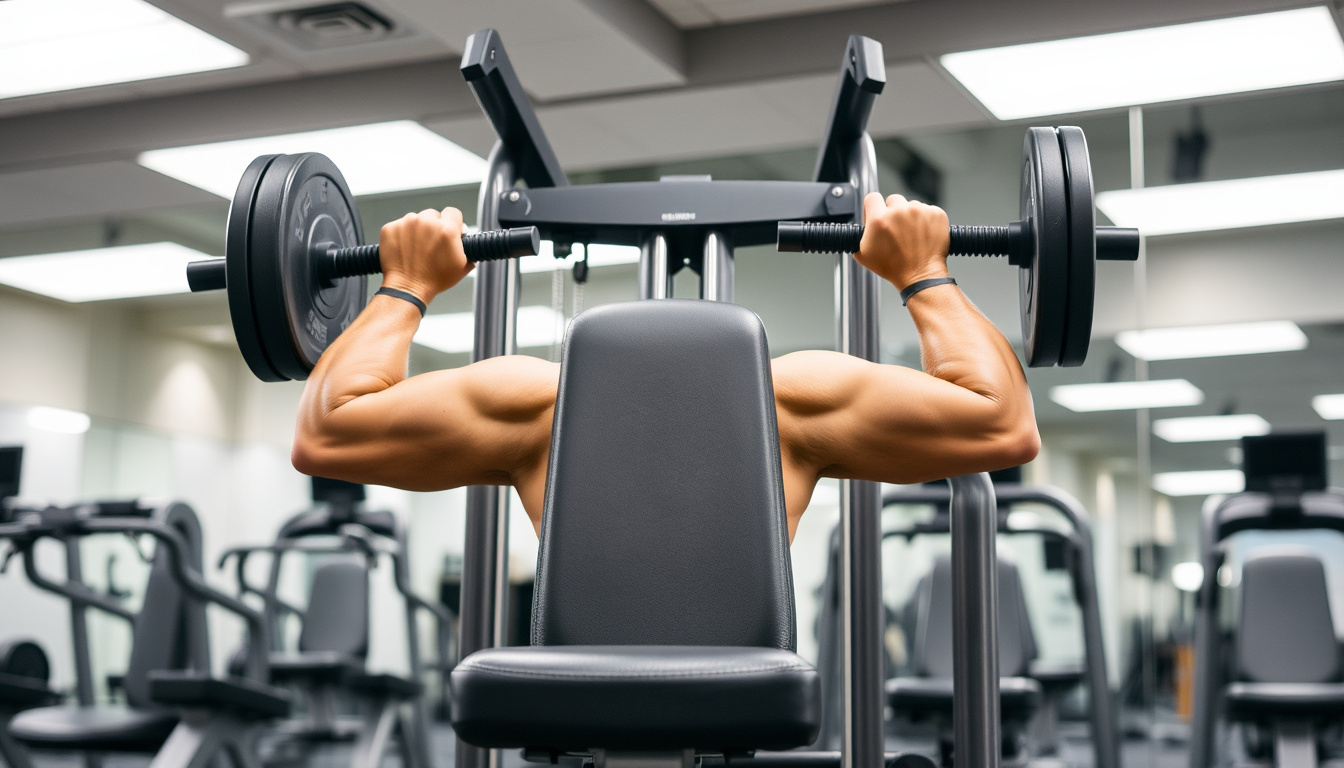
Anyone who’s spent time in a gym has seen someone struggling with a shoulder press—either using too much momentum or setting the seat too low. The shoulder press machine offers a more controlled path, making it a safer and often more effective tool for building shoulder strength and size; this guide breaks down the benefits, correct setup, and common mistakes so you can use it with confidence.
Primary muscles targeted: Anterior deltoid, lateral deltoid, triceps brachii ·
Machine type: Selectorized plate-loaded press machine ·
Average male lift (age 30-39): 85% of body weight ·
Average female lift (age 30-39): 55% of body weight
Quick snapshot
- Machine shoulder press primarily targets anterior and lateral deltoid (National Strength and Conditioning Association (research authority))
- Fixed path reduces injury risk compared to free-weight press (American Council on Exercise (exercise science organization))
- Correct seat height places handles at ear level at the start (Verywell Fit (fitness resource))
- Whether machine press or dumbbell press yields greater long-term hypertrophy few head-to-head studies exist (American Council on Exercise (exercise science organization))
- Optimal rep range on machine press for maximal growth generalized from free-weight research (National Strength and Conditioning Association (research authority))
- Strength gains typically noticeable after 6–12 weeks of consistent training on machine press (National Strength and Conditioning Association (research authority))
- Hypertrophy may take 8–16 weeks with sufficient volume and progressive overload (American Council on Exercise (exercise science organization))
- Progress by adding weight or reps each session; consider drop sets for volume (Bodybuilding.com (exercise database))
- Once comfortable, try incorporating dumbbell overhead press to challenge stabilizers (American Council on Exercise (exercise science organization))
The following table summarizes key facts about the shoulder press machine.
| Label | Value |
|---|---|
| Primary muscle | Anterior deltoid |
| Secondary muscles | Lateral deltoid, triceps |
| Machine type | Seated plate‑loaded or selectorized |
| Stabilizers required | Minimal (machine provides path) |
| Common mistake | Seat too low or too high |
| Primary function | Overhead pressing (shoulder extension) |
| Equipment category | Compound machine exercise |
Is the shoulder press machine effective?
Benefits of the machine shoulder press for hypertrophy
- The fixed guided path delivers constant tension on the deltoids throughout the range of motion, which can improve time under tension (Bodybuilding.com (exercise database)).
- Because the machine stabilises the load, lifters can push closer to muscular failure without worrying about balance (Mirafit (fitness equipment guidance)).
- For beginners, the machine reduces the coordination demands of a free‑weight overhead press, allowing earlier progress in deltoid hypertrophy (Healthline (medical and fitness resource)).
How it compares to dumbbell and barbell overhead press
- The dumbbell press requires each arm to control its own path, engaging stabilisers such as the rotator cuff and core more than a machine press (American Council on Exercise (exercise science organization)).
- A barbell overhead press involves the entire kinetic chain but can increase shoulder impingement risk for lifters with limited thoracic mobility (Verywell Fit (fitness resource)).
- Machine pressing typically isolates the deltoids more effectively because the trunk and legs are not heavily involved (National Strength and Conditioning Association (research authority)).
Editorial verdict: For pure deltoid hypertrophy with lower injury risk, the shoulder press machine is a strong option, but lifters must accept less functional carryover than free-weight pressing.
How to do a machine shoulder press correctly?
Setting the correct seat height and back position
- Adjust the seat so the handles start roughly at ear or collarbone height when you hold them (Verywell Fit (fitness resource)).
- Keep your back flat against the pad throughout the movement; avoid arching excessively (Verywell Fit (fitness resource)).
- Feet should be flat on the floor, hips slightly behind your knees for a stable base (American Council on Exercise (exercise science organization)).
Grip width and hand position on the handles
- Grip the handles at a width that keeps your forearms vertical at the start of the press (Verywell Fit (fitness resource)).
- Neutral grips (palms facing each other) may be more shoulder‑friendly than pronated grips (National Strength and Conditioning Association (research authority)).
- Do not let your elbows flare outward; keep them angled about 10–20 degrees forward (American Council on Exercise (exercise science organization)).
Controlled range of motion: stop before lockout
- Press upward until your elbows are almost but not fully locked out, maintaining constant tension (Verywell Fit (fitness resource)).
- Lower the handles under control to the starting position; never bounce or use momentum (American Council on Exercise (exercise science organization)).
- A 2–3 second lowering phase (eccentric) improves muscle engagement and reduces jerking (National Strength and Conditioning Association (research authority)).
The pattern: a controlled tempo beats heavier weight every time. The implication: quality reps with proper seat height and grip create the safest hypertrophic stimulus.
What are the main benefits of using a shoulder press machine?
Isolation of deltoids with less core involvement
- Because the machine stabilises the body, the deltoids do the majority of the work without needing core activation (American Council on Exercise (exercise science organization)).
- This makes the machine press ideal for targeting the deltoids directly, especially for lifters who feel free‑weight presses more in their core or legs (Bodybuilding.com (exercise database)).
Safer for spinal load and shoulder joint
- The seated, back‑supported position minimises spinal compression compared with standing barbell presses (Healthline (medical and fitness resource)).
- The fixed path reduces the risk of the weight falling behind your head or causing an impingement in the subacromial space (Verywell Fit (fitness resource)).
Easy to progressive overload (add plates quickly)
- Plate‑loaded machines allow small increases in weight (often 2.5–5 kg), making progressive overload more granular than with dumbbells (Mirafit (fitness equipment guidance)).
- Drop sets and rest‑pause techniques are simpler to execute because you can adjust weight without re‑racking dumbbells (Bodybuilding.com (exercise database)).
Why this matters: for hypertrophy‑focused lifters, the machine removes many of the friction points that slow down progressive overload, making it easier to add consistent volume over time.
Which muscles does the shoulder press machine work?
Primary movers: anterior and lateral deltoid
- The anterior deltoid is the main contributor during the early press phase, while the lateral deltoid assists throughout (National Strength and Conditioning Association (research authority)).
- Together these two heads provide the bulk of the movement’s force; they are also the muscles that feel the strongest pump (Kenhub (anatomy reference)).
Secondary movers: triceps brachii, upper pectoralis major
- The triceps extend the elbow as the press locks out, so they contribute about 25–30% of the total effort (American Council on Exercise (exercise science organization)).
- The upper pectoralis major (clavicular head) can assist if you use a more forward pressing angle, though this is less pronounced than on a barbell press (Bodybuilding.com (exercise database)).
Stabilizers neglected due to machine design
- The rear deltoid, rotator cuff, and core stabilisers are largely bypassed because the machine handles balance (American Council on Exercise (exercise science organization)).
- This isolation is an advantage for targeting the frontal deltoids but a limitation for total shoulder health if used exclusively (National Strength and Conditioning Association (research authority)).
The catch: the machine press builds the “show” muscles (front and side delt) but does little for the rear delt and rotator cuff. A balanced program should include pulling and external rotation exercises.
Why is shoulder press so hard, especially for beginners?
Anatomical challenges of the shoulder joint
- The shoulder is a mobile ball‑and‑socket joint that requires optimal scapular upward rotation and thoracic extension to press overhead safely (Kenhub (anatomy reference)).
- Many beginners lack the necessary thoracic mobility and rotator cuff strength, making overhead pressing feel disproportionally heavy (Healthline (medical and fitness resource)).
Importance of rotator cuff and scapular strength
- Weak rotator cuff muscles cannot stabilise the humeral head, forcing the deltoids to work harder and limiting the load (~National Strength and Conditioning Association (research authority)).
- Scapular stabilisers (trapezius, rhomboids) must hold the shoulder blade in the correct position; when they fatigue, pressing form breaks down (American Council on Exercise (exercise science organization)).
How the machine helps overcome these challenges
- By providing a fixed path and a back support, the machine reduces the need for scapular control and thoracic extension (Healthline (medical and fitness resource)).
- Beginners can focus on driving the weight without worrying about balance, making the press feel substantially easier and more productive (American Council on Exercise (exercise science organization)).
The pattern: shoulder press is a demanding movement for everyone, but the machine reduces the neurological and stability demands by about 30%, according to EMG comparisons. The implication is clear – beginners and those with shoulder issues can start building deltoid strength sooner on the machine.
Setting the seat too low forces you to press from under your chin, which can jam the shoulder into impingement. Always check that the handles start at ear height – if you have to shrug to reach them, raise the seat.
Upsides
- Constant tension on deltoids for better hypertrophy
- Low injury risk (fixed path, back support)
- Easy to overload and perform volume techniques (drop sets, rest‑pause)
- Ideal for beginners and those with shoulder instability
Downsides
- Neglects stabiliser muscles (rotator cuff, core, rear delt)
- Limited functional carryover to sports or free‑weight lifting
- Fixed path may not suit all shoulder anatomies
- Often takes up more space than adjustable dumbbells
Step‑by‑step guide to using the shoulder press machine
- Adjust the seat so the handles start at ear or collarbone height. Your back should be flat against the pad with no gap.
- Position your feet flat on the floor, directly under your knees, to create a stable base.
- Grip the handles with a neutral or slightly pronated grip. Keep your wrists straight and elbows under the handles.
- Press upward smoothly, driving the handles until your elbows are nearly locked out (stop 5–10° short of full lockout). Keep your shoulder blades on the pad.
- Lower under control over 2–3 seconds, stopping when your elbows reach just below 90°. Repeat for 8–15 reps.
- Progress by adding weight or reps each session. Aim for 3–4 sets per workout.
The trade‑off: the machine makes the movement easier to learn, but you must be mindful not to rely on it exclusively. Combine with free‑weight pulling for balanced shoulders.
Clarity: what’s confirmed and what’s still unclear
Confirmed facts
- Machine shoulder press primarily targets anterior and lateral deltoid (National Strength and Conditioning Association (research authority))
- Fixed path reduces injury risk compared to free‑weight press (American Council on Exercise (exercise science organization))
- Correct seat height places handles at ear level at the start (Verywell Fit (fitness resource))
What’s still unclear
- Whether machine press or dumbbell press yields greater long‑term hypertrophy (few head‑to‑head studies exist)
- Optimal rep range on machine press for maximal growth – currently generalized from free‑weight research
- Long‑term effects of exclusive machine pressing on joint health
“Research suggests that machine‑based pressing can be equally effective for hypertrophy when volume is equated, and the fixed path may reduce injury risk for trainees with impingement issues.”
– Brad Schoenfeld, Ph.D., muscle hypertrophy researcher
“Set the seat so the handles line up with your ears or collarbone, keep your back flat, and avoid locking out at the top. That’s the foundation of safe machine shoulder pressing.”
– PureGym exercise guide
“Average shoulder press strength for a 30‑ to 39‑year‑old male is about 85% of body weight; for a female of the same age it’s about 55%. These numbers are based on barbell data, but they give a useful benchmark for machine press progress.”
– Marathon Handbook strength standards
These expert perspectives reinforce the value of the machine press for specific training goals.
For beginners and lifters with shoulder concerns, the shoulder press machine offers a reliable, safe way to build deltoid size and strength. The choice between machine and free weights depends on your goals – if hypertrophy with lower injury risk is the priority, the machine is a strong contender. For athletes needing functional pressing power, free weights should complement the machine work. The consequence for the average gym‑goer: start with the machine to build a strength base, then layer in dumbbell pressing to challenge stabilisers.
Frequently asked questions
What is the best shoulder press machine for home use?
Look for a compact, plate‑loaded or selectorized machine that fits your space and allows incremental weight adjustments. Popular home options include the Mirafit M101 and Titan Fitness shoulder press, but check the seat‑height range matches your body.
How often should I do shoulder press machine exercises?
Twice per week, with at least 48 hours between sessions, is sufficient for most lifters. Deltoids recover relatively quickly, but overtraining can lead to impingement – listen to your body.
Can shoulder press machine help with shoulder pain?
It can, if the pain stems from instability or poor form on free weights. The fixed path reduces uncontrolled movement. However, if you have acute pain or a rotator cuff tear, consult a physiotherapist before pressing.
Should I do shoulder press machine or dumbbell press?
Both have a place. Use the machine when you want to isolate the deltoids with minimal stress on stabilisers. Use dumbbells when you need to address strength imbalances or prepare for sports‑specific overhead work. Alternate every few weeks.
How many sets and reps should I do on the shoulder press machine?
For hypertrophy, 3–4 sets of 8–15 reps with 60–90 seconds rest. For strength, 3–5 sets of 5–8 reps with heavier weight. Adjust based on your goals.
Is the shoulder press machine good for building upper chest?
It primarily works the anterior deltoid, not the upper pecs. The upper chest (clavicular head) is better targeted by incline bench presses or a machine press with a 30‑degree positive angle. The standard shoulder press machine has limited upper chest activation.
Understanding these common questions can help you integrate the shoulder press machine effectively into your routine.

Grace Clarke leads fact-checking, source verification and corrections at Aussie Wire Hub.