
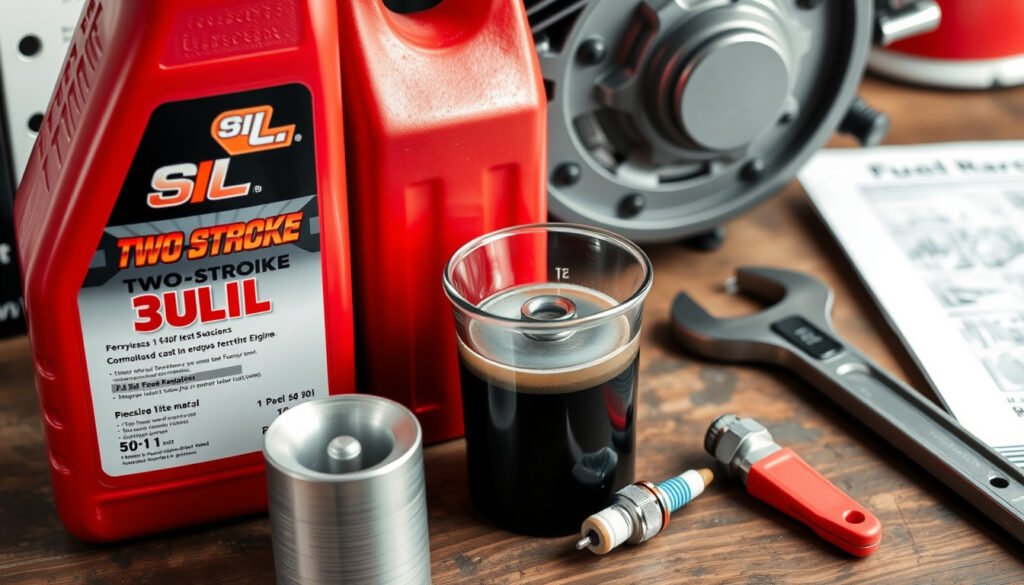
Anyone who’s ever mixed fuel for a chainsaw or dirt bike knows the sinking feeling of wondering if the ratio is right — a small moment with big consequences that can lead to a seized engine or a cloud of smoke. This guide walks through the facts on 2-stroke oil, from mix ratios to brand choice, so you can keep your engine running reliably.
Most common mix ratio for modern 2-stroke engines: 50:1 (50 parts petrol to 1 part oil) · Highest JASO specification for air-cooled engines: JASO FD · Typical oil container size for easy mixing: 1 litre · Estimated proportion of engine failures linked to poor lubrication: over 70% (industry consensus)
Quick snapshot
- 2-stroke oil must be mixed with fuel before use (premix) or injected separately — AMSOIL Blog (lubricant manufacturer)
- JASO FD is the highest specification for air-cooled 2-stroke engines — Motocross Hideout (industry publication)
- Too little oil causes piston seizure more quickly than too much oil — BobIsTheOilGuy (expert forum)
- Which single brand is best depends on engine, climate, and riding conditions — Motocross Hideout (industry publication)
- Whether mixing different oil brands is safe long-term is disputed — BobIsTheOilGuy (expert forum)
- Exact effect of ultra-low ash oils on certain engines is still debated — AMSOIL Blog (lubricant manufacturer)
- Oil quality directly affects engine lifespan — no scheduled service interval can replace correct mixing — Ripon Ground Care (equipment retailer)
- Failure from poor lubrication can happen within minutes of starting a lean mix — Victory Parts (marine parts supplier)
- Expect more synthetic oil options with higher detergent levels — AMSOIL Blog (lubricant manufacturer)
- Stricter emission regulations may push oil formulations toward lower ash content — Victory Parts (marine parts supplier)
Key facts about 2-stroke oil at a glance.
| Attribute | Value |
|---|---|
| Typical mix ratio | 50:1 (50 parts petrol to 1 part oil) |
| Highest JASO classification (air-cooled) | JASO FD |
| Common oil volume for 1 litre of petrol | 20 ml (for 50:1 ratio) |
| Oil types | Synthetic, semi-synthetic, mineral |
| Primary applications | Chainsaws, trimmers, dirt bikes, outboard motors, leaf blowers |
What is the mix ratio for 2-stroke oil?
The ratio tells you how much oil to add to your fuel. The most common modern standard is 50:1 — that means 50 parts petrol to 1 part oil by volume. At this ratio, 1 litre of petrol needs exactly 20 ml of oil, as noted by Ripon Ground Care (garden equipment specialist). For U.S. users, 1 gallon requires 2.6 ounces of oil, according to AMSOIL Blog (lubricant manufacturer).
But not all engines are the same. Older engines may call for 40:1, 32:1, or even 20:1. Victory Parts notes that major outboard manufacturers use three main ratios: 100:1, 50:1, and 25:1. Mercury, Mariner, Tohatsu, Johnson, and Evinrude suggest 50:1, while Yamaha and Suzuki often recommend 100:1 for smaller outboards up to 30 hp.
How much 2-stroke oil is in 1 litre of petrol?
At 50:1, it’s 20 ml. At 40:1, it’s 25 ml. At 32:1, it’s 31.25 ml. The math is simple: divide 1000 (ml in a litre) by the ratio. For 5 litres of fuel at 50:1, Ripon Ground Care says you need 100 ml of oil. Always check your owner’s manual first — ratios differ between engines and brands of oil.
The “universal” 50:1 ratio works for most modern garden and marine engines, but one-size-fits-all advice ignores older equipment that still clogs or seizes on modern oils. Always check the manual.
The implication: using the wrong ratio — especially too little oil — can destroy an engine in minutes, so precise measurement is non-negotiable.
How to mix 2-stroke fuel?
Mixing seems simple, but small mistakes can ruin an engine. The procedure matters as much as the ratio.
- Use a clean fuel can and a dedicated measuring cup (never guess by eye).
- Pour the oil into the can first, then add the petrol — never the reverse.
- Seal the can and shake thoroughly for at least 30 seconds.
- Use the mixed fuel within 30 days; after that, the oil separates and loses lubricity.
Ripon Ground Care (garden equipment specialist) emphasises that adding oil to fuel ensures better mixing. The most common error is adding fuel to oil, which leaves unmixed oil blobs that starve the engine.
What are the key steps for mixing 2-stroke fuel?
- Step 1: Determine the correct ratio from your engine manual.
- Step 2: Measure the oil using a graduated mixing bottle (marked ratios).
- Step 3: Pour oil into empty can, then add petrol.
- Step 4: Close and shake vigorously for 20–30 seconds.
- Step 5: Label the can with the date and ratio.
Stale fuel is the second leading cause of 2-stroke failures after oil starvation. If the fuel has been sitting for more than a month in hot weather, dump it and mix fresh. The old mix can leave gum deposits that ruin the carburetor.
The pattern: fresh fuel and precise mixing prevent the majority of 2-stroke problems.
What Is The Difference Between 2-Stroke And 4-Stroke Engine Oils?
The difference comes down to what each oil does inside the engine. Two-stroke oil is designed to burn completely with the fuel, leaving minimal ash and deposits. Four-stroke oil, on the other hand, stays in the sump and is recirculated — it contains detergents and additives that would foul a 2-stroke spark plug and exhaust port.
According to AMSOIL Blog (lubricant manufacturer), using 4-stroke oil in a 2-stroke engine leads to heavy smoke, carbon buildup on the piston crown, and eventual seizure. The two oils are not interchangeable.
What kind of oil does a 2-stroke use?
Only oil labelled specifically for 2-stroke engines, with a JASO or ISO certification. For air-cooled engines, look for JASO FD or ISO-L-EGD. For water-cooled outboards, TC-W3 is the standard. Never substitute with motor oil, transmission fluid, or vegetable oil.
Is there a difference in two-stroke oils?
Yes: synthetic, semi-synthetic, and mineral. Synthetic offers the best protection at high temperatures and burns cleaner. Mineral is cheaper but leaves more deposits. Semi-synthetic is a middle ground. Brands like STIHL, Motul, Castrol, and Echo each have proprietary blends, but all rely on the same JASO/ISO standards.
Does it matter what brand of 2-stroke oil I use?
Brand matters less than certification. Any oil that meets JASO FD or ISO-L-EGD will protect your engine as long as you use the correct ratio. However, reputable brands like STIHL, Motul, Castrol, and Echo have more consistent quality control. Motocross Hideout (industry publication) notes that unbranded oils often lack the proper additive packages and can cause ring sticking and exhaust port blocking.
Synthetic oils generally outperform mineral oils, especially in high-revving dirt bikes and chainsaws. The AMSOIL SABER Professional, for example, is tested at ratios up to 100:1 and provides a “best-value” at that ratio according to AMSOIL Blog (lubricant manufacturer).
What is the most popular 2-stroke oil?
Consumer surveys and forum threads on BobIsTheOilGuy (expert forum) show that STIHL HP Ultra is the top choice for chainsaws, Motul 710 for dirt bikes, and Castrol Power 1 for marine outboards. Popularity varies by region and engine type, but the common thread is a JASO FD or TC-W3 certification.
What is the best 2-stroke oil to buy?
There is no single best oil. The right choice depends on your engine’s cooling type (air vs water), operating temperature, and the manufacturer’s recommendation. For air-cooled engines used in garden equipment, a JASO FD synthetic is best. For outboards, a TC-W3 certified synthetic is ideal. Always check the manual first.
The “best” oil is the one that meets the right certification for your engine. A $20 bottle of JASO FD synthetic will outperform a $10 mineral oil in terms of engine life and cleanliness, even if both are from the same brand.
The takeaway: certification (JASO FD or ISO-L-EGD) is the real benchmark; brand is secondary.
What happens if you put too much oil in a 2-stroke?
Too much oil — a “rich” mix — causes excessive smoke, spark plug fouling, and carbon buildup in the combustion chamber and exhaust. The engine may run sluggish and struggle to start when hot. However, the damage is gradual. Victory Parts (marine parts supplier) explains that excess oil can also wash oil off the cylinder walls, ironically reducing lubrication.
Too little oil — a “lean” mix — is far more dangerous. It starves the piston and cylinder of lubrication, causing overheating and seizure within minutes. The piston can weld itself to the cylinder wall, requiring a complete rebuild or replacement. Industry consensus on BobIsTheOilGuy (expert forum) states that lean is much more harmful than rich, because a lean mix destroys the engine in seconds, while a rich mix just makes smoke.
Is it better to put too much or too little oil?
If you must err, err on the side of slightly too much (within 10% of the recommended ratio). A 45:1 mix instead of 50:1 will smoke and may foul plugs, but it won’t seize. A 60:1 mix (too little oil) risks immediate and catastrophic failure. The safest approach is to measure precisely using a graduated mixing bottle.
For more information on 2-stroke oil, check out this Hotel Guide.
What kills a two-stroke engine?
The number one cause of 2-stroke engine failure is oil starvation — either from an incorrect mix ratio or a malfunctioning oil injection system. Ripon Ground Care (garden equipment specialist) points out that many beginners think “any oil will do” and end up with a seized piston.
Other common killers: overheating from a lean fuel mixture, stale fuel that clogs the carburetor, dirt ingress through an air filter, and mechanical wear from using mineral oil in a high-RPM engine. Motocross Hideout (industry publication) adds that running the engine with an air leak (cracked intake boot) can lean the mix and cause detonation.
For a more detailed troubleshooting guide, you can also review related step-by-step tutorials that emphasise precision — a mindset that applies directly to mixing fuel.
What to do when a 2-cycle engine suddenly dies?
- Check for spark: remove the spark plug, reconnect the lead, ground the plug against the cylinder, pull the starter. A weak or no spark points to ignition issues.
- Check fuel: is the tank fresh? Is the mix ratio correct? If the fuel smells varnished, drain and refill with fresh mix.
- Check compression: thumb over the spark plug hole — you should feel strong pressure. Low compression means piston or ring damage.
- If none of these, inspect the carburetor for blockages or a ruptured diaphragm.
The pattern: most sudden 2-stroke failures are fuel-related. Fix the fuel, fix the engine.
Six engine conditions, one pattern: oil ratio is the most critical variable.
| Engine type | Typical ratio | Oil per litre (ml) | Common brand guidance |
|---|---|---|---|
| Modern garden equipment (chainsaws, trimmers) | 50:1 | 20 | STIHL, Husqvarna, Echo |
| Older garden equipment (pre-2000) | 32:1–40:1 | 25–31.25 | Homelite, McCulloch |
| Dirt bikes (motocross) | 50:1 (modern) / 40:1 (older) | 20–25 | Motul 710, Maxima K2 |
| Small outboards (≤30 hp, Yamaha/Suzuki) | 100:1 | 10 | Yamalube 100:1 |
| Large outboards (Mercury, Evinrude, Johnson) | 50:1 | 20 | Quicksilver, Evinrude XD100 |
| High-RPM racing engines | 32:1–50:1 (depends) | 20–31.25 | Castrol A747, Motul 800 |
Seven oil specs, one pattern: JASO FD and ISO-L-EGD are the gold standards for air-cooled engines.
| Specification | Application | Key requirement |
|---|---|---|
| JASO FA | Basic air-cooled | Lubricity, minimal deposit control |
| JASO FB | Improved air-cooled | Better detergency and smoke suppression |
| JASO FC | Advanced air-cooled | Low smoke, good piston cleanliness |
| JASO FD | Highest air-cooled | Best detergency, high-temp protection, low ash |
| ISO-L-EGB | Medium performance | Equivalent to JASO FB |
| ISO-L-EGC | High performance | Equivalent to JASO FC |
| ISO-L-EGD | Highest performance | Equivalent to JASO FD |
Upsides
- Synthetic oils extend engine life when used correctly
- JASO/ISO certifications make selection simple
- Premix allows precise control over lubrication
- Modern oils burn cleaner, reducing exhaust deposits
Downsides
- Incorrect ratio causes rapid engine damage
- Synthetic oils cost 2–3× more than mineral
- Premixed fuel has short shelf life (30 days)
- Some additives may not suit all engines
What we know and what’s still debated
Confirmed facts
- 2-stroke oil must be mixed with fuel before use (premix) or injected separately — AMSOIL Blog
- JASO FD is the highest specification for air-cooled 2-stroke engines — Motocross Hideout
- Too little oil causes piston seizure more quickly than too much oil — BobIsTheOilGuy
What’s unclear
- Which single brand is best depends on engine, climate, and riding conditions — Motocross Hideout
- Whether mixing different oil brands is safe long-term is disputed — BobIsTheOilGuy
- Exact effect of ultra-low ash oils on certain engines is still debated — AMSOIL Blog
“Use STIHL 2-stroke oil at 50:1 ratio for all models.”
— STIHL (official guidance)
“Two-stroke oil is designed to burn completely while lubricating, unlike 4-stroke oil which is recirculated.”
— NAPA Auto Parts Blog
“A 50:1 mix equals 20 ml of oil per 1 liter of petrol.”
— Ripon Ground Care (garden equipment specialist)
For the average chainsaw or dirt bike owner, the choice is clear: use a JASO FD synthetic oil at the ratio specified by the engine manufacturer, measure carefully with a graduated bottle, and never let mixed fuel sit for more than a month. For the DIY mechanic who runs multiple engines, investing in a quality synthetic oil that works across different ratios (like AMSOIL SABER Professional at 100:1 for small outboards or 50:1 for garden gear) saves time and protects equipment. The alternative — a seized piston or a costly teardown — is a risk no one should take.
For a detailed breakdown of fuel-to-oil ratios and brand recommendations, refer to this comprehensive 2-stroke oil mix ratios guide.
Frequently asked questions
Can I use regular motor oil in a 2-stroke engine?
No. Motor oil is not designed to burn cleanly and will leave carbon deposits that cause piston ring sticking and exhaust port blocking. Only use oil labelled for 2-stroke engines.
How long does premixed 2-stroke fuel stay usable?
Up to 30 days when stored in a sealed, cool container. After that, the oil can separate and the fuel begins to degrade, leading to hard starting and deposits.
Is synthetic 2-stroke oil worth the extra cost?
Yes, for engines that run at high RPM or under heavy load (chainsaws, dirt bikes, outboards). Synthetic oil offers better thermal stability, reduces deposits, and extends engine life. For light-duty lawn trimmers, mineral oil may be adequate.
What does JASO FD mean on a bottle of 2-stroke oil?
JASO FD is the highest certification for air-cooled 2-stroke engine oils. It guarantees low smoke, high detergency, and excellent high-temperature protection. Oils with this rating are suitable for most modern garden and dirt bike engines.
Can I mix different brands of 2-stroke oil?
It is not recommended as a long-term practice. Different additive packages may react unpredictably. If you must mix, use only oils with the same JASO/ISO rating and avoid mixing synthetic with mineral.
Do I need to use 2-stroke oil if my engine has oil injection?
Yes. Oil injection systems still require 2-stroke oil designed for injectors (usually TC-W3 for marine or JASO FD for air-cooled). Never use regular motor oil in an injection system.

Grace Clarke leads fact-checking, source verification and corrections at Aussie Wire Hub.