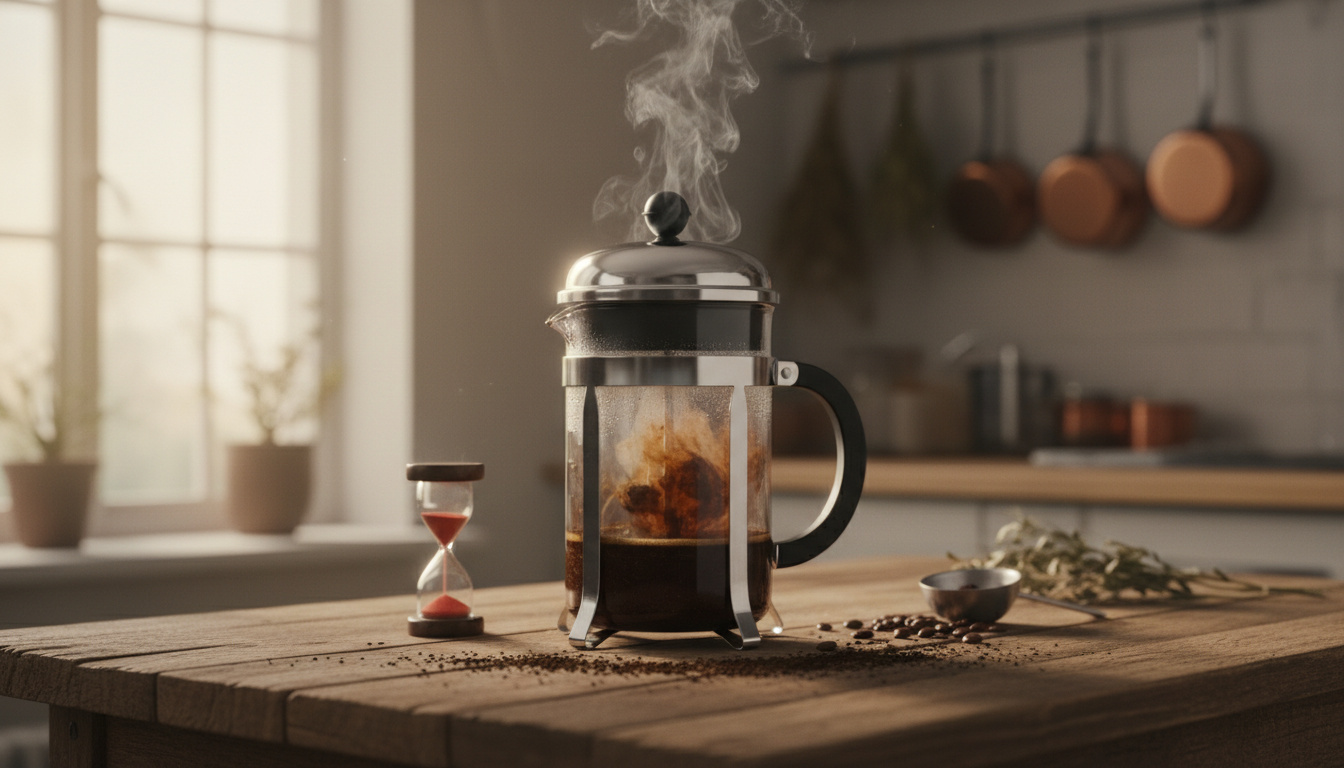
French press brewing—also known as the cafetière or press pot method—relies on full immersion steeping to produce a rich, full-bodied cup that preserves the natural oils often trapped by paper filters. The technique demands attention to four critical variables: coffee-to-water ratio, coarse grind size, water temperature between 195-205°F (91-96°C), and a four-minute steeping window. When executed correctly, this method yields balanced extraction with minimal sediment, though minor errors in timing or grind consistency quickly result in bitter, gritty, or weak results.
Unlike drip brewing, the French press places the user in direct control of every extraction phase, from the initial bloom that releases carbon dioxide to the slow plunge that separates grounds from liquid. Specialty roasting guides emphasize that mastery requires understanding not just the steps, but the underlying chemistry that governs flavor development.
This guide synthesizes protocols from industry standards and expert practitioners to eliminate guesswork. Whether troubleshooting a bitter aftertaste or calibrating ratios for different press sizes, the following sections provide measurable benchmarks for consistent results.
What Is the Ideal Coffee-to-Water Ratio for French Press?
- The Specialty Coffee Association recommends a 1:16.6 golden ratio (approximately 60g of coffee per liter of water) for optimal extraction yield.
- Weighing ingredients with a digital scale produces more consistent results than volume measurements like tablespoons, which vary by bean density and roast level.
- For a standard 34-ounce (1L) press, use 54-56g of coffee with 850-900g of water.
- Smaller 3-cup presses require 17-21g of coffee to 275-300ml of water, maintaining the same 1:15-1:17 range.
- A 1:15 ratio produces a stronger, more concentrated cup, while 1:17 yields a lighter, more tea-like extraction.
- Filtered water prevents off-flavors from chlorine or minerals that interfere with proper taste profiling.
| Press Size | Coffee Amount | Water Volume | Ratio |
|---|---|---|---|
| 3-Cup (~12oz) | 17-21g | 275-300ml | 1:15-1:17 |
| 4-Cup (~20oz) | 27g | 430ml | 1:16 |
| 8-Cup/34oz (~1L) | 54-56g | 850-900ml | 1:15-1:17 |
| SCA Standard (per liter) | 60g | 1000ml | 1:16.6 |
What Grind Size and Water Temperature Should You Use?
Grind Consistency and Texture
The French press requires a coarse grind resembling breadcrumbs or coarse sea salt. Brewing documentation confirms that finer grinds slip through the mesh filter, creating sediment and gritty texture, while also clogging the plunger mechanism. Super-coarse grinds, however, may under-extract, producing sour or weak results.
Temperature Control and Calibration
Water temperature must sit between 195-205°F (91-96°C). Bring water to a full boil (212°F), then rest for 30 seconds to reach the target range. Temperatures exceeding 205°F extract harsh bitter compounds; temperatures below 195°F result in under-extraction and sourness. Preheating the glass press with a hot water rinse prevents thermal shock and maintains stability during the four-minute steep.
A burr grinder produces uniform particle size essential for French press success. Blade grinders create inconsistent fragments ranging from powder to boulders; the fine dust inevitably slips through the mesh screen, clouding the cup with silt.
Step-by-Step Guide: How to Brew French Press Coffee Correctly
Equipment Preparation and Preheating
Gather a French press, digital scale, timer, wooden or plastic spoon (to avoid scratching glass), burr grinder, and filtered water. Remove the plunger assembly, pour near-boiling water into the empty press to preheat the glass, then discard after 30 seconds. This step prevents the brew temperature from dropping during extraction.
Blooming and Saturation
Add coarse grounds to the preheated press. Pour approximately double the coffee weight in water—100-110ml for 56g of coffee—to initiate the bloom. Roasting experts recommend stirring gently to wet all grounds and waiting 30-60 seconds for carbon dioxide to escape, ensuring even flavor extraction rather than channeling.
Steeping and Separation
Pour the remaining water in a circular motion to saturate all grounds evenly, bringing the total to the target weight. Place the lid with the plunger fully raised. Steep for exactly four minutes. Some protocols suggest breaking the crust—formed by floating grounds—at the one-minute mark with a gentle stir to promote uniform extraction, though this remains optional. The precision required here rivals careful cooking techniques like those in a Chicken Burrito Bowl – Easy Chipotle Copycat Recipe, where ingredient ratios determine final quality.
Plunging and Immediate Decanting
After four minutes, press the plunger down slowly and steadily over 30-60 seconds until it rests just above the ground bed or at the bottom. Pour the coffee immediately into mugs or a thermal carafe; leaving liquid in contact with the grounds continues extraction, rapidly introducing bitterness.
How to Avoid Gritty Coffee and Other Common French Press Mistakes
Preventing Sediment and Grit
Sediment indicates either too fine a grind or pressing too aggressively. Maintain a coarse grind and depress the plunger slowly without forcing it. When breaking the crust during steeping, avoid disturbing the settled grounds at the bottom, as agitation releases fine particles that pass through the mesh.
Correcting Bitterness and Weakness
Expert analysis identifies three primary causes of bitter French press coffee: steeping beyond 4:30 minutes, using water above 205°F, or failing to decant immediately after pressing. Weak or under-extracted brews typically result from insufficient steep time (under 3:30 minutes), water below 195°F, or clogged filters due to overly fine grinding.
Leaving brewed coffee in the press with the grounds continues extraction, rapidly producing bitter compounds. Decant immediately into a thermal carafe or mugs to preserve flavor clarity and prevent the harsh, dry aftertaste characteristic of over-steeped immersion coffee.
Disassemble the plunger immediately after serving. Rinse the mesh and glass with hot water daily to preserve essential oils; avoid soap for daily cleaning. Weekly, soak the components in hot water with mild detergent or a dishwasher tablet, scrubbing the mesh with a non-abrasive brush to prevent rancid residue buildup.
How Long Does the Brewing Process Take?
The complete French press workflow follows a precise chronological sequence from preparation to serving:
- — Preheat the French press and serving vessels with boiling water, then discard.
- — Bloom phase: Pour double-weight water over grounds, stir gently, and wait 45 seconds for degassing.
- — Steep: Add remaining water, cover with plunger raised, and maintain contact for four minutes total.
- — Press: Slowly depress the plunger over 30-60 seconds without forcing.
- — Serve: Decant immediately to halt extraction and prevent bitterness.
What Are the Fixed Standards Versus Adjustable Variables?
| Established Standards | Adjustable Variables |
|---|---|
| SCA Golden Ratio 1:16.6 (60g/L) | Personal strength preference (1:15 to 1:17 range) |
| Water temperature 195-205°F (91-96°C) | Exact resting time after boil (30-45 seconds) |
| Minimum 4-minute steep time | Stirring frequency (once at 1:00 minute vs. none) |
| Coarse grind requirement | Specific coarseness calibration (medium-coarse vs. coarse) |
| Immediate decanting after pressing | Preheating duration and technique |
| Filtered water quality | Bloom time variation (30-60 seconds) |
What Makes French Press Brewing Unique?
French press distinguishes itself from drip methods through full immersion extraction. Unlike pour-over systems that pass water briefly through grounds, the press maintains constant contact between water and coffee for the entire steep duration. This prolonged contact extracts more soluble solids and oils, creating the characteristic heavy body and rich mouthfeel.
The metal mesh filter permits these oils to remain in the final cup, whereas paper filters absorb lipids that contribute to texture and aroma. Specialty protocols note that this unfiltered approach demands stricter attention to grind uniformity, as the metal screen cannot retain fine particles as effectively as paper.
What Do Leading Coffee Authorities Recommend?
The Specialty Coffee Association endorses a 1:16.6 golden ratio for immersion methods, utilizing 195-205°F water and coarse grind to achieve optimal extraction yields between 18-22%.
Specialty Coffee Association standards via Stumptown Coffee
Use a 1:15 ratio with medium-coarse grind, steep for four minutes with a stir at one minute, press slowly, and decant fully to avoid over-extraction bitterness. Avoid super-coarse grinds that under-extract.
James Hoffmann, Coffee Expert
Essential Practices for Consistent French Press Results
Mastering French press brewing requires adherence to the 1:15-1:17 ratio, strict temperature control between 195-205°F, a uniform coarse grind, and a four-minute steep followed by immediate decanting. Precision in measurement and timing eliminates the common failures of bitterness and sediment. For travelers seeking perfect coffee rituals abroad, timing matters as much as brewing—consider the Best Time to Visit Sri Lanka – Optimal Months by Coast when planning your next coffee tourism destination.
Frequently Asked Questions
What is the best coffee for French press?
Medium to dark roasts with coarse grind work best, as they withstand full immersion extraction without becoming bitter. Freshly roasted beans ground immediately before brewing yield optimal flavor and aromatic complexity.
How to clean French press properly?
Disassemble the plunger immediately after use. Rinse the mesh and glass with hot water daily; avoid soap to preserve beneficial oils. Weekly, soak components in hot water with mild detergent, scrubbing the mesh with a non-abrasive brush to remove residue.
Can I use pre-ground coffee in a French press?
Pre-ground coffee works only if labeled specifically for French press with coarse texture. Standard pre-ground coffee is too fine, causing sediment and clogging. Purchase whole beans and grind immediately before brewing for best results.
Why is my French press coffee bitter?
Bitterness results from over-steeping beyond 4:30 minutes, water temperatures exceeding 205°F, or leaving brewed coffee in contact with grounds. Pour immediately after plunging to stop extraction.
Why does my French press coffee taste weak?
Weak extraction typically stems from water below 195°F, insufficient steep time under 3:30 minutes, or grind size too fine causing clogging. Verify temperature with a thermometer and extend steep time to four minutes.

Liam O'Brien covers Australian politics and public affairs for Aussie Wire Hub.