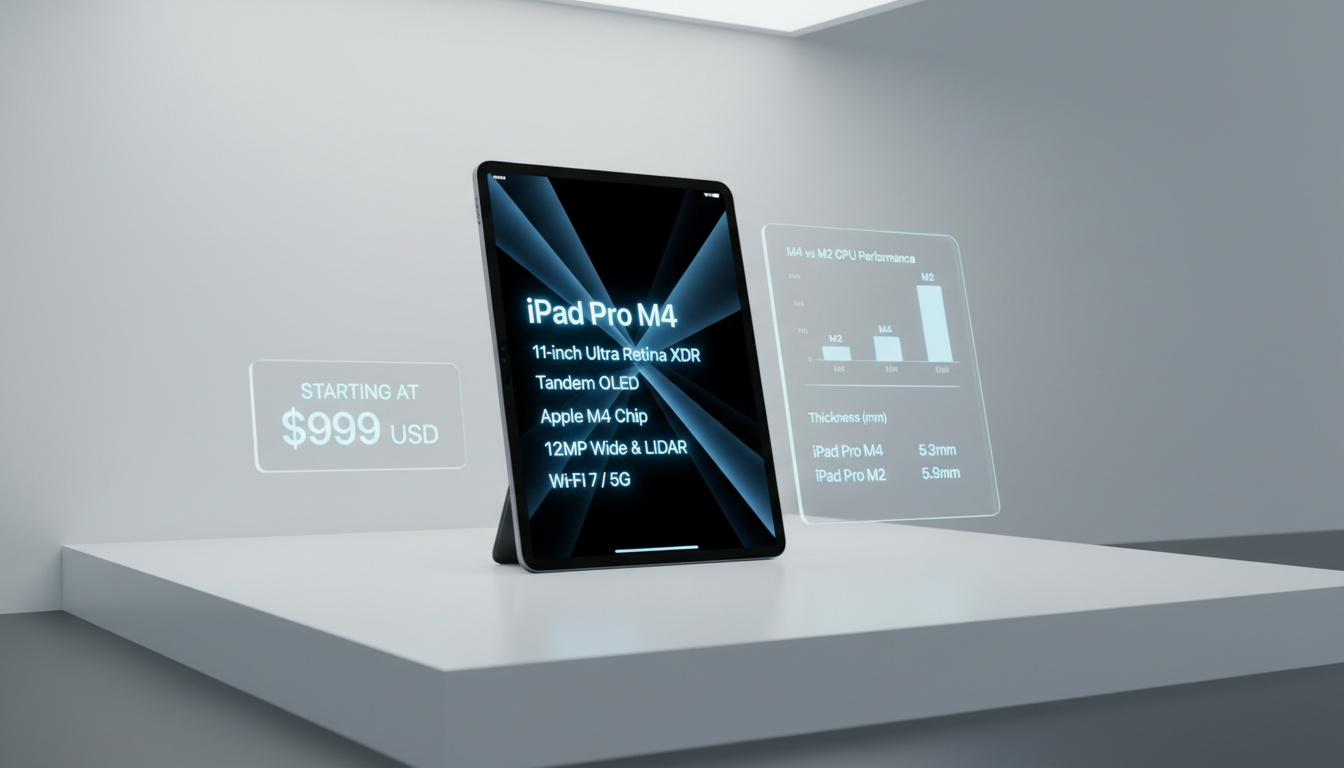
The iPad Pro 11-inch (M4, 2024) represents Apple’s thinnest hardware release to date, measuring just 5.3 millimeters while housing the company’s most powerful tablet chip. Released in May 2024, this generation introduces the Ultra Retina XDR Tandem OLED display to the 11-inch form factor for the first time, alongside a 10-core M4 processor designed specifically for artificial intelligence workloads and professional creative applications.
Apple positioned the device as a mobile studio capable of editing 4K ProRes video and rendering complex 3D scenes, yet the hardware maintains a weight of only 444 grams for the Wi-Fi configuration. The shift to tandem OLED technology delivers 1600 nits of peak HDR brightness while improving power efficiency, though the premium pricing and iPadOS limitations require careful evaluation against workflow requirements.
What Are the Key Specs of the iPad Pro 11-Inch?
The 2024 model departs significantly from its predecessors through fundamental display and processing architecture changes. Technical specifications confirm the device utilizes a dual-layer OLED panel combined with the M4’s second-generation 3-nanometer process.
- Display: 11-inch Ultra Retina XDR Tandem OLED, 120Hz ProMotion, P3 wide color
- Chip: Apple M4 with 10-core CPU, 10-core GPU, and 16-core Neural Engine
- Cameras: 12MP Wide rear with LiDAR, 12MP Ultra Wide front (landscape orientation)
- Battery: Up to 10 hours video playback, USB-C charging
Key architectural improvements distinguish this generation:
- At 5.3mm thickness, it represents the thinnest product Apple has ever manufactured
- Tandem OLED architecture delivers 1600 nits peak HDR brightness with improved longevity over single-layer panels
- Optional nano-texture glass etched at the nanometer level reduces glare on 1TB and 2TB configurations
- Thunderbolt 4 USB-C port enables 40Gb/s data transfer and external 6K display support
- M4 Neural Engine processes 38 trillion operations per second for on-device AI tasks
- Four-speaker audio system supports Dolby Atmos spatial audio
- Studio-quality three-mic array enables high-fidelity audio recording
| Attribute | Specification |
|---|---|
| Dimensions | 249.7 x 177.5 x 5.3 mm |
| Weight (Wi-Fi) | 444g |
| Weight (Cellular) | 446g |
| Display Resolution | 2420 x 1668 pixels (264 ppi) |
| Peak Brightness | 1600 nits (HDR), 1000 nits (SDR) |
| Processor | Apple M4 (10-core CPU, 10-core GPU) |
| RAM | 8GB (256GB/512GB), 16GB (1TB/2TB) |
| Storage Tiers | 256GB, 512GB, 1TB, 2TB |
| Rear Camera | 12MP Wide, f/1.8, LiDAR Scanner |
| Front Camera | 12MP Ultra Wide, f/2.4, Center Stage |
| Wireless | Wi-Fi 6E, Bluetooth 5.3, 5G (optional) |
| Connector | USB-C with Thunderbolt / USB 4 |
How Much Does the iPad Pro 11-Inch Cost?
Apple’s official pricing starts at $999 for the 256GB Wi-Fi model in the United States, with the cellular configuration commanding a $200 premium. International markets see significant variation; the base model retails for approximately ₹99,900 in India, though regional taxes and import duties create substantial differences in final costs. For international buyers monitoring exchange rates, our Currency conversion guide provides current valuation contexts.
Storage upgrades follow a steep curve. The 512GB model adds $200, while the 1TB tier increases the base price by $600. The 2TB maximum configuration exceeds $1,999. Nano-texture glass, available exclusively on 1TB and 2TB variants, may incur additional costs depending on regional availability.
Accessory pricing further impacts total investment. The Apple Pencil Pro retails separately at $129, while the Magic Keyboard for the 11-inch model costs $299. Bundle promotions occasionally appear through carriers, particularly when purchasing with cellular plans, though inventory fluctuations indicate base models sometimes face discontinuation ahead of new releases.
iPad Pro 11-Inch vs. 13-Inch: Key Differences
Both M4 iPad Pro models share identical internal specifications, creating a decision matrix based purely on physical constraints and display preferences rather than performance capabilities.
Portability and Dimensions
The 11-inch model measures 249.7 x 177.5 x 5.3 mm and weighs 444 grams, compared to the 13-inch variant at 281.6 x 215.5 x 5.1 mm and 579 grams. The 135-gram weight difference significantly impacts one-handed usage and extended handheld drawing sessions.
The 11-inch model’s reduced footprint allows it to fit into standard messenger bags and small backpacks that accommodate the 13-inch version only with difficulty. Both models feature the same 5.3mm thickness.
Display Characteristics
While both utilize Tandem OLED technology with identical 1600-nit peak brightness and ProMotion refresh rates, the 13-inch display provides 33% more screen area for multitasking. Split-screen workflows display more content natively, reducing the need for zoom gestures when editing documents alongside reference materials.
Battery and Thermal Constraints
Both models advertise 10-hour video playback, though the 13-inch contains a physically larger battery to power its expanded display real estate. Thermal throttling remains minimal on both sizes during sustained 4K video exports, though the 13-inch’s larger chassis provides marginally better heat dissipation during extended rendering tasks.
Is the 11-Inch iPad Pro Worth Buying?
Value assessment depends entirely on workflow requirements and existing device ecosystems. The M4 chip delivers 20-50% faster GPU performance compared to the M2 iPad Air, making the investment compelling for 3D artists and video editors.
Professional Use Cases
The Neural Engine’s 38 trillion operations per second enable real-time AI features in applications like Adobe Photoshop and DaVinci Resolve. Photographers benefit from the Tandem OLED’s color accuracy, while the LiDAR scanner supports professional 3D scanning applications for architecture and design.
Creative professionals requiring AI acceleration, photographers needing OLED color precision, and mobile workers prioritizing cellular connectivity in a sub-500g package will extract maximum value from the premium pricing.
Limitations and Trade-offs
Despite the desktop-class M4 processor, user reports indicate that iPadOS constraints prevent full laptop replacement for developers and those requiring specific macOS applications. External monitor support remains limited to single-display mirroring without full extended desktop capabilities.
iPadOS lacks native support for Final Cut Pro’s full feature set and restricts background processing for certain professional applications. Buyers expecting macOS functionality will face adaptation requirements.
iPad Pro 11-Inch Release Date and History
The 11-inch form factor evolved through five distinct generations since its introduction, with 2024 marking the most significant architectural departure.
- October 2018: Apple introduces the first 11-inch iPad Pro with A12X Bionic chip, Liquid Retina LCD display, and USB-C connector, replacing the previous 10.5-inch model. — Apple Inc.
- March 2020: Second generation adds A12Z Bionic chip with enhanced GPU core, LiDAR scanner for AR applications, and Magic Keyboard compatibility. — Apple Inc.
- April 2021: M1 chip brings desktop-class performance to the iPad Pro line, introducing 5G cellular options and Center Stage camera technology. — Apple Inc.
- October 2022: M2 iteration adds hover detection for Apple Pencil, ProRes video recording, and Wi-Fi 6E connectivity while maintaining the same chassis design. — Apple Inc.
- May 2024: Current M4 generation launches with Tandem OLED display technology, 5.3mm redesigned chassis, and dedicated Neural Engine for AI workloads. — Apple Inc.
What Do We Know for Certain About the iPad Pro 11-Inch?
Separating confirmed specifications from marketing terminology requires examining Apple’s technical documentation against independent testing limitations.
| Established Facts | Remaining Uncertainties |
|---|---|
| Confirmed dimensions of 249.7 x 177.5 x 5.3 mm and 444g weight (Wi-Fi) through official technical specifications | Exact battery capacity in watt-hours remains undisclosed by Apple |
| Tandem OLED display verified to deliver 1600 nits HDR brightness through hardware testing | Long-term display longevity compared to traditional OLED panels unverified due to recent release |
| M4 chip configuration with 10-core CPU/GPU confirmed via system information | Specific timeline for iPadOS updates beyond the standard five-year support window remains unspecified |
| Starting price of $999 for 256GB model established across all markets | Potential M5 refresh timeline remains speculative with no confirmed announcement dates |
| Thunderbolt 4 connectivity supports 6K external displays at 60Hz | Real-world battery degradation rates under constant cellular usage require longitudinal study |
How Does the iPad Pro 11-Inch Fit Into the Tablet Market?
The device occupies a unique position between traditional tablets and ultraportable laptops, competing directly with the Microsoft Surface Pro and Samsung Galaxy Tab S9 Ultra while maintaining distinct ecosystem advantages through iPadOS.
Cellular connectivity differentiates the iPad Pro from most laptop competitors, allowing persistent internet access without tethering. For users evaluating mobile data options, our Compare internet plans analysis provides current carrier comparisons for tablet-specific data plans.
The accessory ecosystem, including the Apple Pencil Pro and Magic Keyboard, transforms the hardware from consumption device to production tool. However, the pricing gap between the iPad Pro and iPad Air (M2) creates market segmentation where casual users may find the Air’s Liquid Retina display and M2 chip sufficient for non-professional workflows.
What Are Experts Saying About the iPad Pro 11-Inch?
Independent evaluation confirms the hardware excellence while noting software constraints.
The best iPad ever.
Praised for portability, display quality, and pro performance; suitable for creators but iPadOS limits full desktop potential.
— Community Analysis
Should You Buy the iPad Pro 11-Inch in 2024?
The iPad Pro 11-inch (M4) justifies its $999 entry price for creative professionals requiring OLED color accuracy, AI-accelerated workflows, and cellular connectivity in a 444-gram package, though users needing full desktop operating system capabilities should evaluate macOS alternatives or accept iPadOS limitations before purchasing.
Frequently Asked Questions
Best accessories for iPad Pro 11-inch?
The Apple Pencil Pro ($129) enables pressure-sensitive drawing with haptic feedback, while the Magic Keyboard ($299) adds backlit keys and trackpad functionality. Both utilize the Smart Connector, eliminating Bluetooth pairing requirements.
How does the iPad Pro 11-inch compare to the iPad Air?
The Pro features Tandem OLED versus the Air’s LCD, and the M4 chip delivers 20-50% faster GPU performance than the Air’s M2. The Air starts at $599 with M2, making it suitable for casual users who don’t require pro displays or AI acceleration.
What is the nano-texture glass option?
Available exclusively on 1TB and 2TB models, nano-texture glass undergoes nanometer-level etching to reduce glare while maintaining contrast. It requires specific cleaning cloths to avoid damage.
Does the iPad Pro 11-inch support external displays?
The Thunderbolt port supports one external display up to 6K resolution at 60Hz or 4K displays with ProMotion. Extended desktop mode works with iPadOS, though some apps support only mirroring.
Is 256GB storage sufficient for professional work?
For 4K ProRes video editing, 256GB fills quickly during multi-project workflows. The USB-C port allows external SSD expansion, though internal storage provides faster read/write speeds for active projects.
Can the iPad Pro 11-inch replace a laptop?
For video editing, digital illustration, and document processing, yes. For software development requiring specific compilers or macOS-only applications, limitations persist. The Magic Keyboard adds laptop-style input but iPadOS restricts certain background processes.
What comes included in the box?
Apple includes the iPad Pro, USB-C charge cable, and 20W power adapter. The Apple Pencil Pro and Magic Keyboard require separate purchases.

Liam O'Brien covers Australian politics and public affairs for Aussie Wire Hub.