Copper remains one of the most closely monitored commodities in global markets, serving as a critical indicator of economic health and industrial activity. The current copper price per kilogram reflects a complex interplay of supply constraints, shifting demand patterns, and macroeconomic forces that continue to reshape the metals landscape. For buyers, investors, and industry professionals, understanding the precise per-kilogram pricing—alongside the broader trends driving those figures—has become essential for informed decision-making.
Trading on benchmark exchanges including the London Metal Exchange and COMEX, copper pricing moves in real-time based on futures contracts and spot market activity. Recent market data shows significant volatility, with prices experiencing substantial gains over the past twelve months while facing downward pressure in more recent weeks. This dynamic creates both opportunities and challenges for those tracking the copper market.
What Is the Current Copper Price Per KG?
The current copper price stands at approximately $12.68 per kilogram, based on the spot price of $5.7520 per pound with a daily trading range of $5.7520 to $5.7570 per pound. This figure represents the most recent available data from major commodity exchanges, though market conditions can shift rapidly throughout trading sessions.
For those requiring conversions across different measurement units, the following benchmarks apply: futures trading shows $5.8860 per pound with a previous close of $5.7645, while the standard COMEX contract size of 25,000 pounds influences institutional pricing. Per tonne, copper trades between $12,680.99 and $12,884.49, with the per-gram rate standing at approximately $0.0127. Converting between units requires multiplying the pound price by 2.20462 to obtain the kilogram equivalent.
- Spot price per pound: Bid $5.7520 / Ask $5.7570 according to Kitco live data
- Futures price: $5.8860 per pound on COMEX benchmarks
- 12-month performance: Up approximately 28% year-over-year
- March 2026 performance: Down nearly 10% during the month
- All-time high: $6.58 per pound reached in January 2026
- Current range: Trading within a $5.5 to $5.56 band amid geopolitical uncertainty
| Metric | Value | Unit |
|---|---|---|
| Spot Price | 12.6810 | USD/kg |
| Futures Price | 5.8860 | USD/lb |
| Daily Change | -0.67% | 4-week |
| Monthly Change | -5.89% | To Mar 31 |
| Yearly Change | +28% | 12-month |
| Per Tonne Range | 12,680.99-12,884.49 | USD |
Copper Price Chart and Recent Trends
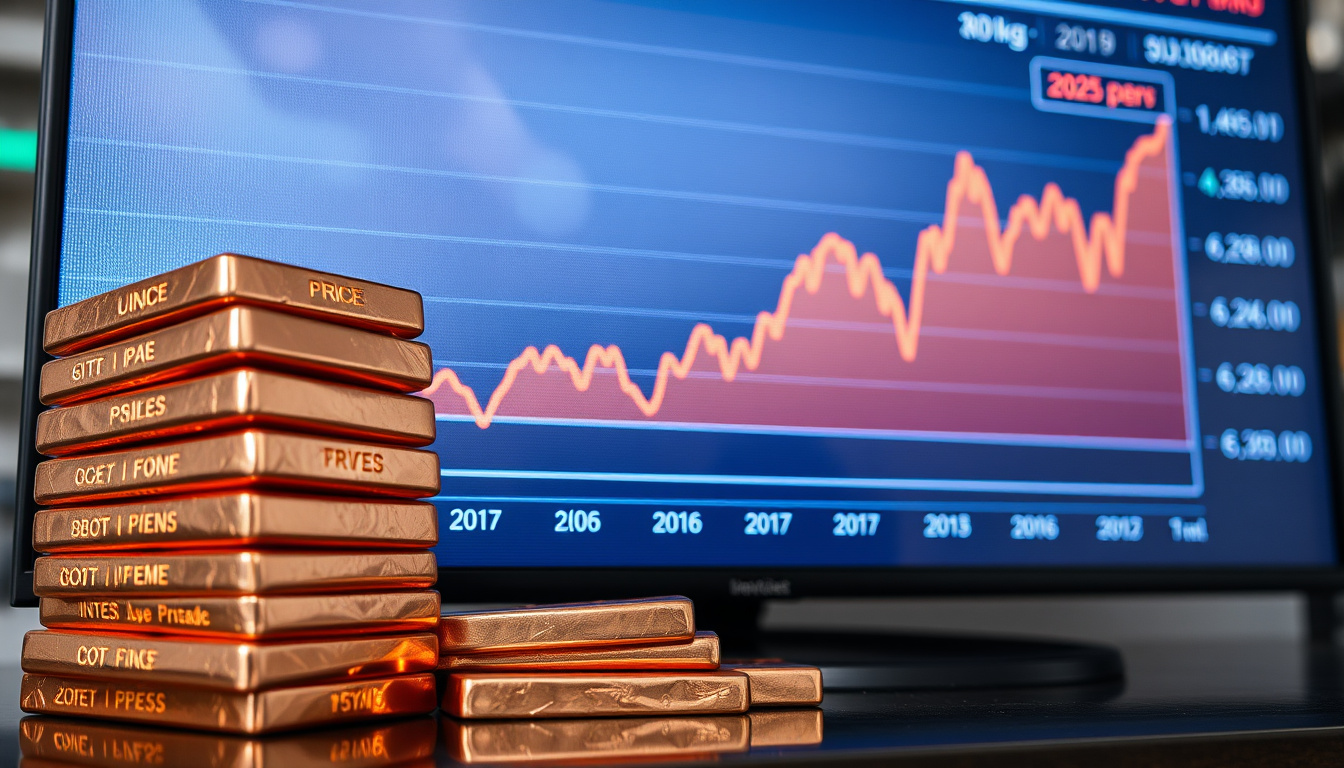
Examining copper price trends reveals a market characterized by significant volatility and shifting sentiment. The past twelve months have demonstrated remarkable strength, with prices climbing approximately 28% as demand for the red metal intensified across multiple sectors. However, the most recent month tells a different story, with March 2026 bringing losses of nearly 10% as inflationary concerns and slowing industrial activity weighed on market participants.
Understanding the Recent Pullback
The copper market experienced its first weekly gain following Middle East tensions, supported by developments in US-Iran diplomacy that eased some supply concerns. Despite this modest recovery, underlying pressures remain evident. Data from Trading Economics indicates that prices peaked at $5.81 per pound in recent sessions, though the broader trend reflects hesitation among traders navigating conflicting economic signals.
Performance Across Different Timeframes
Breaking down performance by timeframe provides context for different investor perspectives. The four-week decline of 0.67% represents a relatively modest correction within a longer bullish trend. The monthly figure of -5.89% reflects more substantial selling pressure, while the yearly comparison of +10.40% to +10.67% depending on measurement date shows sustained strength despite recent weakness.
Real-time copper prices are available through multiple platforms including Kitco for spot quotes, Investing.com for charting tools, and official exchange data from LME and COMEX. Prices may vary slightly between sources due to different data collection timestamps.
What Is the Copper Price Forecast for 2025?
Analyst projections for copper prices indicate mixed expectations as the market navigates uncertain economic terrain. Forecasts suggest prices could decline to approximately $5.47 per pound by quarter-end 2026 before recovering to around $6.22 per pound within twelve months. These predictions carry inherent uncertainty, reflecting the difficulty of forecasting commodity markets amid evolving geopolitical and macroeconomic conditions.
Factors Supporting Higher Prices
Several structural factors could support copper prices in the medium to long term. The global transition toward electric vehicles represents a significant demand driver, as copper serves essential roles in batteries, wiring, and charging infrastructure. China continues as both the world’s largest copper consumer and a major producing nation, meaning developments in Chinese economic policy and industrial activity carry substantial weight for global pricing. Central bank policies and infrastructure spending initiatives across major economies may provide additional upward pressure.
Headwinds and Risks to the Forecast
Conversely, multiple factors could constrain copper price appreciation. Inflation concerns continue to influence market sentiment, with the potential for interest rate adjustments creating uncertainty. Energy prices affect both production costs and industrial demand, while geopolitical developments in key producing regions such as Chile and the Democratic Republic of Congo can disrupt supply chains. The recent restart of Codelco’s El Teniente smelter following a previous collapse demonstrates how supply-side disruptions can temporarily normalize after periods of instability.
Commodity price forecasts are inherently speculative and based on available data and modeling assumptions. Market conditions can shift rapidly based on unexpected economic data, policy changes, or supply disruptions. The projections mentioned reflect consensus views from analytical sources but should not be interpreted as guaranteed outcomes.
Why Is the Copper Price Rising or Falling?
Understanding copper price movements requires examining the fundamental supply and demand dynamics that drive market direction. As the third most-used metal globally, copper serves as a barometer for industrial health and economic activity across sectors ranging from construction to electronics to renewable energy infrastructure.
Supply-Side Considerations
Copper mining remains concentrated in several key regions, with Chile alone accounting for more than one-third of global production. Other significant producing countries include Peru, the Democratic Republic of Congo, China, the United States, Australia, Indonesia, Zambia, Canada, and Poland. This geographic diversity means that disruptions anywhere in the supply chain can influence global pricing. The restart of major processing facilities, such as Codelco’s El Teniente operations, represents important developments that gradually normalize supply following disruptions.
Demand Drivers and Market Sentiment
The electric vehicle revolution has emerged as a particularly powerful demand catalyst, with copper requirements per vehicle significantly exceeding those of traditional automobiles. Grid infrastructure development, renewable energy installations, and consumer electronics all contribute to sustained demand growth. Meanwhile, macroeconomic factors including Federal Reserve monetary policy expectations, inflation trends, and global trade dynamics create additional layers of complexity for copper market analysis.
Copper markets can experience significant price swings over short periods. The CVOL volatility index on COMEX measures market uncertainty, and elevated readings suggest heightened risk for traders. Those making purchasing or investment decisions based on current prices should consider the potential for rapid market movements.
Historical Copper Price Per KG Timeline
Examining copper’s price history provides context for evaluating current market positioning. The commodity has experienced notable cycles over decades, with significant highs and lows reflecting changing economic conditions, technological developments, and evolving supply dynamics.
- January 2026: Copper reached an all-time high of $6.58 per pound, marking a historic peak driven by strong demand and supply concerns
- March 31, 2026: Prices settled at $5.55 per pound, representing a daily gain of 1.30% but a monthly decline of 5.89%
- Q1 2026: Trading range of $5.5 to $5.55 per pound as the market consolidated following the January peak
- Historical Context: The long-term low point occurred at approximately $0.60 per pound in 1988, demonstrating the substantial appreciation in copper values over subsequent decades
Historical chart data spanning multiple decades is available through platforms like Macrotrends, enabling detailed analysis of price cycles and long-term trends. For those interested in examining specific periods or identifying patterns, these resources provide comprehensive historical perspectives.
Understanding What Is Known and Unknown
Transparency about the boundaries of available information serves readers seeking accurate understanding of copper market dynamics. While substantial data exists regarding current pricing and historical trends, certain aspects of the market remain subject to uncertainty.
Established Information
- Current spot and futures prices from benchmark exchanges
- 12-month and recent monthly performance data
- Major producing regions and countries
- Key demand drivers including electric vehicles
- Historical price peaks and troughs
Information With Uncertainty
- Precise timing of future price movements
- Impact of unannounced supply disruptions
- Short-term forecast accuracy
- Specific scrap market data and recycling rates
- Regional pricing variations outside major exchanges
The Role of Copper in Global Markets
Copper occupies a unique position among commodities due to its widespread industrial applications and conductivity properties. The metal serves as a critical component in electrical wiring, plumbing systems, roofing materials, and numerous electronic devices. Its applications in renewable energy infrastructure, including solar panels and wind turbines, have expanded the demand profile beyond traditional sectors.
Trading on exchanges like the LME and COMEX provides standardized pricing mechanisms that influence contracts globally. The LME offers monthly averages, warehouse stock data, and three-month futures covering the first six months of copper contracts. COMEX integrates US market risk through its CVOL volatility index, providing traders with additional tools for assessing market conditions. The Multi-Commodity Exchange in India facilitates copper trading for regional market participants, connecting local demand with international pricing.
For industry participants, investors, and policy analysts, monitoring copper prices provides insights into broader economic trends. The metal’s sensitivity to industrial activity makes it a leading indicator for manufacturing sectors, while its role in green energy transition positions it as a strategic material for future economic development.
“Copper’s dual role as both an industrial workhorse and a clean energy essential creates sustained demand pressures that distinguish it from many other commodities.”
Summary and Key Takeaways
The current copper price per kilogram stands at approximately $12.68 USD, reflecting spot market activity of $5.7520 per pound on major exchanges. While the 12-month performance shows gains of approximately 28%, recent months have experienced volatility with March 2026 declining nearly 10%. Analysts project potential weakness toward $5.47 per pound before recovery to around $6.22 within twelve months, though these forecasts carry inherent uncertainty.
For those tracking related market movements and commodity dynamics, exploring resources on ASX: PLS – Share Price, Performance and Lithium Outlook and 1000 Baht to AUD – Current Rate and Conversion Guide may provide additional context for understanding broader commodity and currency interconnections in the metals markets.
Frequently Asked Questions
What factors affect copper price movements?
Copper prices respond to supply disruptions, industrial demand shifts, macroeconomic conditions, central bank policies, and geopolitical developments. Key factors include production in Chile and Peru, Chinese consumption patterns, electric vehicle demand, and energy costs.
How do I convert copper price from pounds to kilograms?
Multiply the price per pound by 2.20462 to obtain the price per kilogram. For example, $5.7520 per pound equals approximately $12.68 per kilogram.
Where can I check live copper prices?
Live copper prices are available through Kitco, Trading Economics, Investing.com, and official exchange websites for LME and COMEX. Each source provides real-time or near-real-time data with varying update frequencies.
What is the standard copper futures contract size?
The standard COMEX copper futures contract represents 25,000 pounds. This standardized size enables consistent pricing and facilitates trading across the futures market.
Why has copper reached historically high prices?
Multiple factors contribute to elevated copper prices, including sustained demand from infrastructure development, electric vehicle production, and renewable energy projects, combined with supply constraints and processing disruptions in major producing countries.
How does the LME copper price differ from COMEX?
The London Metal Exchange and COMEX both offer copper futures but operate with different specifications, settlement procedures, and market participants. LME provides monthly averages and warehouse stock data, while COMEX incorporates US market risk through its volatility indices.
Is copper price going up or down in 2026?
Short-term forecasts suggest potential decline to around $5.47 per pound by quarter-end 2026 before recovering toward $6.22 within twelve months. However, commodity prices are inherently volatile and subject to rapid changes based on market conditions.

Liam O'Brien covers Australian politics and public affairs for Aussie Wire Hub.