
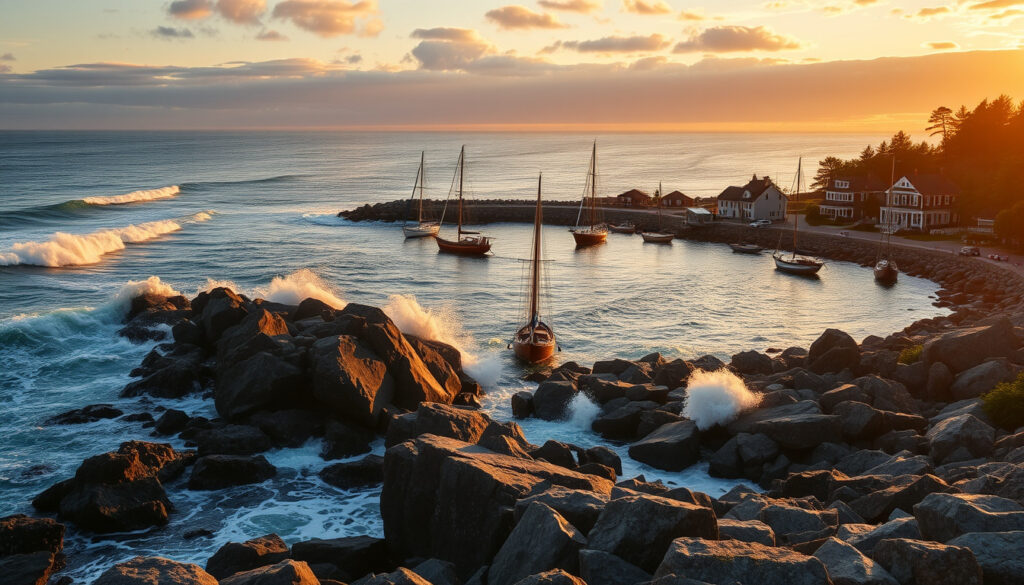
Manchester-by-the-Sea is a historic coastal town nestled along Essex County, Massachusetts, renowned for its rocky promontories, secluded coves, and the steady rhythm of ocean breezes. The town has long attracted visitors drawn to its unspoiled shores, sleek sailboats gliding through Manchester Harbor, and the distinctive character of a New England fishing village that grew into a Gilded Age retreat for the wealthy. Today, it stands as one of the North Shore’s most cherished destinations, offering a rare blend of natural beauty, preserved architecture, and a deep connection to American maritime history.
For many, the name first surfaced in association with the Academy Award-winning 2016 film of the same name, leading to questions about whether such a place genuinely exists. It does. Manchester-by-the-Sea is a real town with roots stretching back to the early 17th century, predating the film by nearly four centuries. The town has served as a summer playground for presidents and princes, exported salt cod to distant shores, and maintained a sense of coastal charm that continues to captivate visitors from across the country.
Where Is Manchester by the Sea and Is It a Real Place?
Manchester-by-the-Sea occupies a prime stretch of coastline along Massachusetts Bay in northeastern Essex County. Situated roughly 30 miles northeast of Boston, the town lies within the state’s coastal region known as the North Shore. Its eastern border meets the Atlantic Ocean directly, while neighboring communities include Beverly to the south and Gloucester to the north. The Essex Coastal Scenic Byway passes through the area, providing a picturesque route for those traveling by car from Boston and surrounding communities.
Yes, Manchester-by-the-Sea is absolutely a real place with a documented history dating back to the 1620s. The area was originally settled as part of a 1629 land grant granted to the Massachusetts Bay Colony by King Charles I. The first documented settlers arrived in June aboard the ship Talbot, establishing what would become one of New England’s oldest coastal communities. The town was officially incorporated as “Manchester” in 1645 and operated under that name for more than three centuries before adopting its current designation in 1990.
- The town was renamed Manchester-by-the-Sea in 1990 by a single-vote margin to distinguish it from other New England communities sharing the name
- First settled in June aboard the Talbot, with settlers drawn by the safe harbor and fishing opportunities
- The original settlement was known as “Jeoffereyes Creeke” before adopting its 17th-century name
- By 1772, with just 900 residents, it led the region in salt cod exports to Spain and the Caribbean
- The mid-1800s transformation into a summer resort attracted presidents, princes, and theatrical luminaries
- Massachusetts Bay Colony’s eastern coastline provides moderate temperatures influenced by ocean currents
| Fact | Detail |
|---|---|
| Founded | 1629 (land grant); settled 1643 |
| Incorporated | 1645 as “Manchester” |
| Renamed | 1990 to Manchester-by-the-Sea |
| Area | 18.3 square miles total |
| County | Essex County, Massachusetts |
| Major Exports (Historical) | Salt cod to Spain and the Caribbean |
| Peak Summer Population | Significantly exceeds permanent residents |
| First Police Force | Established 1897 |
How to Get to Manchester-by-the-Sea
The most common route from Boston involves heading north on Route 128 before transitioning onto local roads that wind through the coastal communities of the North Shore. The drive takes approximately 45 minutes to an hour depending on traffic conditions. The MBTA commuter rail also serves the town via the Rockport line, with regular service connecting Boston’s North Station to Manchester’s station near the harbor. Those unfamiliar with the area may find that mapping Manchester Harbor, Beach Street, or Masconomo Park provides the most reliable landmarks for navigation purposes.
What Is Manchester by the Sea Known For?
Manchester-by-the-Sea carries a reputation built on several distinctive pillars: its maritime heritage, its transformation into an elite summer destination during the Gilded Age, its preserved historical architecture, and more recently, its association with the critically acclaimed 2016 film. The town’s identity has been shaped by generations of fishermen, sea captains, wealthy summer visitors, and permanent residents who have collectively maintained its coastal New England character.
The economy that sustained the community through its first two centuries centered on farming, fishing, and seafaring. By the late 1700s, Manchester had emerged as a leader in salt cod production, shipping preserved fish to markets in Spain and the Caribbean. This maritime focus left lasting marks on the community’s architecture and cultural identity, themes that the Manchester Historical Museum continues to preserve and display today.
Why Is It Called Manchester-by-the-Sea?
The naming history of Manchester-by-the-Sea reflects both practical necessity and local sentiment. The original settlement bore the name “Jeoffereyes Creeke,” drawn from local geography. In 1645, settlers successfully petitioned to rename the community “Manchester,” likely drawing inspiration from the English industrial city. For more than 340 years, this remained the official designation.
The “by-the-Sea” suffix gained popularity during the mid-1800s as other New England communities adopted the Manchester name, creating confusion among travelers, postal workers, and train conductors. The informal addition helped distinguish the Massachusetts coastal town from its inland counterparts. By the late 20th century, the distinction had become so embedded in local usage that residents voted in 1990 to formalize the change. The margin was remarkably slim: a single vote separated the town from keeping its original name.
The Population of Manchester-by-the-Sea
The town has remained small by design and tradition. Historical census data from 1772 recorded approximately 900 residents, making Manchester the smallest town in Essex County at that time. By the early 21st century, population estimates indicated roughly 5,400 permanent residents. However, these figures do not capture the seasonal fluctuation that has defined the community since the mid-1800s. During summer months, the town’s population swells considerably as vacationers, second-home owners, and day visitors converge on the beaches and harbor.
While current census data can provide updated figures, the town’s official website and local historical records remain the most reliable sources for understanding Manchester-by-the-Sea’s demographic patterns. The seasonal population surge continues to be a defining characteristic of the community.
The History of Manchester-by-the-Sea
The area that would become Manchester-by-the-Sea was originally inhabited by Algonquin-speaking indigenous peoples before European contact. Land rights were formally acquired through a combination of purchases and a final payment made to Masconomo’s grandson, with full acquisition completed by approximately 1700. The first families established permanent residences by 1643, settling alongside a minister who provided spiritual leadership to the small fishing community.
The Manchester Historical Museum operates from the Abigail Hooper Trask House, a structure built in 1823 by a self-made female entrepreneur whose story exemplifies the opportunities and challenges faced by early residents. Exhibits include salt cod fishing equipment and documents that trace the industry’s central role in the local economy.
The town’s most dramatic transformation occurred during the mid-1800s when poet Richard Henry Dana’s visit in 1845 effectively “discovered” Manchester for wealthy summer visitors. The construction of the Masconomo House hotel by theatrical figure Julius Booth attracted presidents, princes, ambassadors, and leading performers of the era. This period of exclusivity gave way to the Gilded Age, when the community hosted foreign embassies and served as the summer playground for America’s most affluent families.
Landmarks from this era include the Coolidge Memorial Building, dedicated in 1887 as both library and Civil War memorial honoring 23 Manchester men lost to that conflict. The nearby Highwood estate, constructed in 1897 for millionaire William P. Walker, represents the opulent residential architecture that defined the summer colony period.
The Manchester Historical Museum offers guided tours exploring salt cod production, Gilded Age estates, and notable local figures like Robert Booth. Visitors should also explore the Manchester Village Historic District, where vernacular architecture spanning the 17th through early 20th centuries has been carefully preserved. The Coolidge Memorial Building and surrounding civic structures provide additional context for understanding the community’s development.
Best Things to Do in Manchester-by-the-Sea
The town offers a range of activities that cater to different interests, from outdoor recreation on its distinctive beaches to cultural exploration through historic sites and local shops. Summer months bring the strongest offerings, with beaches fully accessible, harbor activities in full swing, and local businesses operating at peak capacity. Year-round visitors can still enjoy historic architecture, scenic walks, and the authentic character of a working coastal community.
The Best Beaches in Manchester-by-the-Sea
The North Shore Alliance lists several beaches within the town, each offering a different coastal experience. Singing Beach remains the most famous, named for the distinctive sound that wet sand produces when walked upon. The phenomenon results from the unique mineral composition of local sand particles, creating a musical quality that has delighted visitors for generations.
Black Beach and White Beach offer more secluded alternatives, with distinctive coloring derived from local rock and shell compositions. Magnolia Beach and West Manchester Beach round out the options, providing additional stretches of coastline for visitors seeking quieter spots. All beaches showcase the rocky promontories and hidden coves that characterize the North Shore coastline, offering sweeping ocean views and opportunities for beachcombing, swimming, and sunbathing.
Historic Districts and Architecture
The Manchester Village Historic District represents one of the region’s best-preserved collections of New England vernacular architecture. Buildings spanning from the 17th century through the early 20th century line the streets near the harbor, providing a tangible record of the town’s evolution. Walking tours offer opportunities to examine colonial farmhouses, sea captains’ homes, and Gilded Age estates that collectively tell the story of changing times and tastes.
The Highwood estate, once the summer residence of millionaire William P. Walker, now features trails and preserved stable structures that visitors can explore. Such estates serve as physical reminders of the town’s era as a destination for America’s wealthiest families, a chapter that left lasting architectural impressions on the community.
Shopping, Dining, and Local Culture
Beach Street serves as the commercial heart of the downtown area, featuring specialty shops selling items that reflect both local tastes and tourist interests. Visitors can find beach supplies, local art, handmade crafts, and culinary treats ranging from fresh pastries to specialty food items. The Manchester Harbor Boat Club area provides access to harbor cruises, fishing charters, and sailing excursions that take advantage of the protected waters and prevailing ocean breezes.
Many local businesses operate on seasonal schedules, with reduced hours or temporary closures during fall, winter, and early spring. Visitors planning off-season trips should verify operating hours in advance and be prepared for a quieter atmosphere that, while less crowded, may offer limited access to certain attractions and dining options.
Outdoor Activities and Nature
Beyond beach activities, the area supports hiking along coastal trails, bird watching, and photography opportunities focused on the harbor, rocky shorelines, and historic architecture. The preserved estates and their grounds offer additional space for exploration, with many areas open to the public for walking and nature appreciation.
Timeline of Key Events
The following chronology highlights significant milestones in Manchester-by-the-Sea’s development from indigenous territory through modern times.
- — King Charles I grants the land comprising modern-day Manchester-by-the-Sea to the Massachusetts Bay Colony as part of a broader land concession.
- — First permanent families settle in the area alongside a minister, establishing the foundations of organized community life.
- — The settlement is officially incorporated as “Manchester,” replacing the earlier geographic designation of “Jeoffereyes Creeke.”
- — With a population of 900 residents, Manchester becomes the smallest town in Essex County yet leads the region in salt cod exports to international markets.
- — Poet Richard Henry Dana visits the area, beginning a transformation that will establish Manchester as a premier summer resort for wealthy Americans.
- — The Coolidge Memorial Building opens as a combined library, Grand Army of the Republic headquarters, and Civil War memorial.
- — The town establishes its first full-time police force, marking a new era of professional municipal governance.
- — Voters approve the addition of “by-the-Sea” to the official town name by a single-vote margin, formalizing a distinction that had been informal for over a century.
Facts and Uncertainties: What We Know and What Remains Unclear
Established Information
- Settlement began in the 1620s following the 1629 land grant from Charles I
- The first settlers arrived in June aboard the ship Talbot
- Full land rights from indigenous inhabitants were acquired by 1700
- The town led regional salt cod exports during the colonial period
- The Gilded Age transformation into an elite summer resort began in the mid-1800s
- Official renaming to Manchester-by-the-Sea occurred in 1990
- The Manchester Historical Museum preserves local heritage in the historic Abigail Hooper Trask House
Information That Remains Unclear
- Precise current population figures require verification from official census sources
- Specific details regarding filming locations for the 2016 film require additional documentation
- The exact dates when various beaches opened to public access are not consistently recorded
- Comprehensive climate data including average temperatures and precipitation patterns requires compilation from meteorological records
- The complete history of certain historic estates and their transition between owners lacks comprehensive documentation
The Gilded Age Legacy and Modern Identity
The period from the mid-1800s through the early 20th century fundamentally reshaped Manchester-by-the-Sea’s character and reputation. What had been a working fishing community became a summer destination for America’s elite, with foreign embassies establishing temporary quarters and theatrical luminaries frequenting the Masconomo House hotel. This chapter left architectural marks that survive today in the form of preserved estates, historic district designations, and cultural institutions that continue to interpret this period of affluence.
The North Shore Magazine has documented how the town’s identity evolved from indigenous fishing grounds through colonial settlement to Gilded Age playground and modern residential community. Each era has contributed layers to the town’s character, creating a place where maritime heritage coexists with architectural elegance and natural beauty.
Contemporary Manchester-by-the-Sea maintains much of the charm that attracted wealthy summer visitors generations ago. The rocky promontories, cool ocean breezes, and protected harbor continue to define the visitor experience. Yet the town has also evolved into a year-round residential community with a diverse population that includes artists, professionals, and families drawn by the quality of life that coastal living provides.
Sources and Perspectives
The safe harbor, streams, hills, and fishing opportunities at “Jeoffereyes Creeke” drew the first settlers to this remarkable piece of New England coastline, establishing a community that would grow and transform across four centuries.
— Manchester Harbor Boat Club Historical Records
The Masconomo House hotel, built by theatrical figure Julius Booth, became the social center of a summer colony that attracted presidents, princes, ambassadors, and leading performers of the era.
— Historical documentation from local archives
Information for this article has been drawn from multiple authoritative sources including the Manchester-by-the-Sea Historical Society, municipal records, regional historical organizations, and tourism resources maintained by state and local agencies. Where details remain uncertain, that uncertainty has been noted to maintain accuracy.
Summary
Manchester-by-the-Sea stands as a testament to New England’s rich coastal heritage, having evolved from a 17th-century fishing settlement through a Gilded Age transformation into one of the region’s most distinctive communities. The town offers visitors a rare combination of natural beauty, preserved architecture, historical significance, and authentic coastal character. Whether exploring Singing Beach, wandering through the Manchester Village Historic District, or learning about the salt cod trade at the local museum, visitors find a place that has successfully maintained its identity across nearly four centuries of American history. For those planning a visit to the North Shore, Manchester-by-the-Sea provides an experience that connects the present with a past vividly preserved in its landscapes, structures, and traditions. Those interested in exploring coastal destinations and travel timing may find the North Shore communities worth including in their planning considerations.
Frequently Asked Questions
What is the population of Manchester-by-the-Sea?
Current census estimates place the permanent population at approximately 5,400 residents. However, the population swells significantly during summer months due to vacationers and seasonal visitors.
Are there public beaches in Manchester-by-the-Sea?
Yes, the town maintains several public beach areas including Singing Beach, Black Beach, White Beach, Magnolia Beach, and West Manchester Beach, each offering distinct coastal experiences.
Did the Manchester-by-the-Sea movie use real locations?
While the 2016 film brought significant attention to the town, specific filming location details require verification from production records. The town itself provided inspiration and settings for the narrative.
How far is Manchester-by-the-Sea from Boston?
The town is located approximately 30 miles northeast of Boston, with a driving time of 45 minutes to an hour via Route 128 and local roads. Commuter rail service also connects the two communities.
When is the best time to visit Manchester-by-the-Sea?
Summer months offer the most active beach season and full operation of local businesses. Spring and fall provide a quieter atmosphere for exploring historic sites and enjoying coastal scenery.
What is Singing Beach known for?
Singing Beach is named for the musical sound produced by walking on its wet sand, a phenomenon caused by the unique mineral composition of local beach material. It is among the most popular beaches in the area.
Can you visit the Manchester Historical Museum year-round?
The museum operates from the historic Abigail Hooper Trask House and offers tours and programs. Visitors should verify current operating schedules, as hours may vary by season.
Is Manchester-by-the-Sea an expensive place to visit?
The town has a reputation for affluence, with higher property values and corresponding costs for housing, dining, and certain activities. However, beach access and many outdoor attractions remain free or low-cost.
What historic architecture can be seen in Manchester-by-the-Sea?
The Manchester Village Historic District showcases vernacular architecture spanning the 17th through early 20th centuries, including colonial farmhouses, sea captains’ homes, and Gilded Age estates.
How did Manchester-by-the-Sea get its name?
Originally settled as “Jeoffereyes Creeke,” the town was renamed “Manchester” in 1645 at settlers’ request. The “by-the-Sea” suffix was added informally in the mid-1800s and made official in 1990.

Liam O'Brien covers Australian politics and public affairs for Aussie Wire Hub.