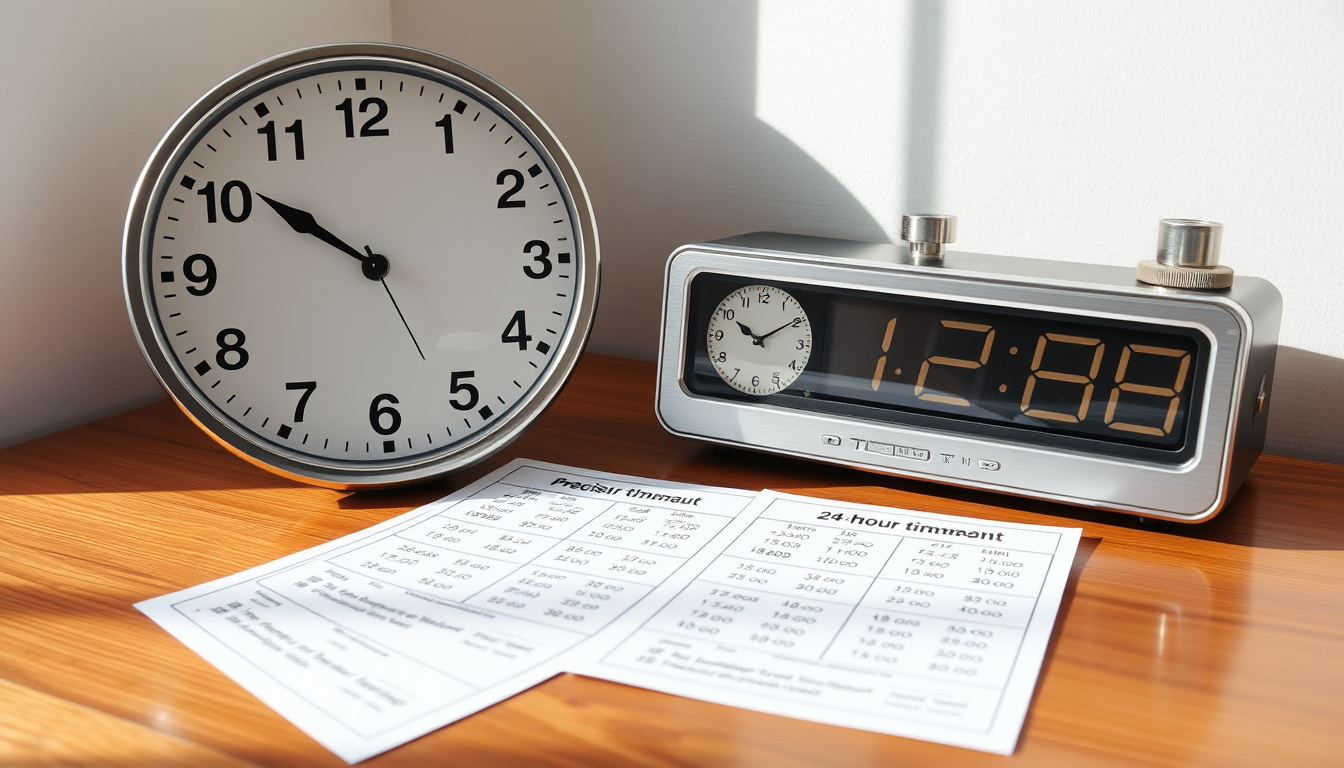
If you’ve ever stared at a flight departure time written as “18:45” and wondered whether that means you’ll be boarding at 6:45 in the morning or evening, you’re not alone. The 24-hour clock—the global standard for everything from hospital schedules to international train timetables—eliminates that confusion entirely. Below, you’ll find a complete conversion guide built from authoritative conversion tables and official sources.
Day cycle: 00:00 to 23:59 · Noon: 12:00 · Midnight start: 00:00 · PM offset: +12 hours · Max hour: 23
Quick snapshot
- 24:00 exact usage varies by country and context (NWCG)
- 24-hour clock adoption varies by region—some English-speaking countries still favor 12-hour casually (Wikipedia)
- Global transport, aviation, and healthcare continue standardizing on 24-hour time (World Population Review)
These key facts anchor the conversion tables and rules that follow.
| Label | Value |
|---|---|
| Format range | 00:00 – 23:59 |
| Noon equivalent | 12:00 |
| Midnight | 00:00 |
| 1 PM | 13:00 |
| 7 PM | 19:00 |
| Noon in military time | 1200 |
| Midnight in military time | 0000 or 2400 |
What is the 24-hour time?
The 24-hour clock is a time format that runs continuously from 00:00 (midnight) to 23:59, counting all 24 hours of the day in a single cycle. Unlike the 12-hour clock, it uses no AM/PM designators—every hour has a unique number, eliminating the ambiguity between morning and evening times.
History of 24-hour clock
The 24-hour system traces its roots to ancient Egyptian astronomy, where sundials divided daylight into 10 hours plus twilight hours. By the 20th century, most countries adopted it as their national standard, though English-speaking nations retained the 12-hour cycle for everyday use.
Difference from 12-hour format
The 12-hour clock divides the day into two identical 12-hour periods labeled AM (ante meridiem, before noon) and PM (post meridiem, after noon). This creates the “12-hour rollover” problem: 12:00 can mean either midnight or noon, depending on context. The World Atlas explains that 24-hour format avoids this confusion entirely by counting hours straight through from 0 to 23.
World Population Review (Data Publisher on global time usage)
In actual practice, most countries use both timescales. The 24-hour scale is used for precision applications such as transit and airline schedules.
What is 7pm on a 24-hour clock?
7 PM converts to 19:00 in 24-hour format. The rule is straightforward: for any PM hour, add 12 to the hour value. Since 7 plus 12 equals 19, you get 19:00. The minutes remain unchanged—7:30 PM becomes 19:30, and 7:45 PM becomes 19:45.
PM to 24-hour steps
- Identify the PM hour (1 through 12)
- Add 12 to that hour number
- Keep the minutes exactly as they are
- Write the result as HH:MM
Common evening examples
Converting PM times to 24-hour format follows the same pattern across all evening hours. Gigacalculator’s conversion table confirms that Gigacalculator (Conversion Tool Provider) uses this rule consistently: 1 PM equals 13:00, 2 PM equals 14:00, continuing through 11 PM equals 23:00.
ByteBloc (Help Guide Publisher)
All you need to do is add 12 to any time in the PM to get 24-hour format time.
For anyone reading international schedules—whether catching a train in Europe or tracking a flight departure globally—the PM-to-24 rule (add 12) is the single conversion you need most often.
Is 24 00 12am or PM?
Neither. 00:00 represents the start of a new day (midnight) in 24-hour format, not an AM or PM designation. The 12-hour clock assigns midnight to 12:00 AM, but the 24-hour system uses 00:00 for that same moment. The notation 24:00 is sometimes used to indicate the end of a day (23:59’s successor) in scheduling contexts.
Midnight conventions
The Gigacalculator conversion resource confirms: 00:00 in 24-hour format equals 12:00 AM (midnight) in 12-hour format. The minutes remain at :00 in both systems, but the hour label differs. According to NWCG (Official Military Training Resource), military charts list both 0000 and 2400 as acceptable midnight notations.
00:00 vs 24:00
The difference is subtle but practical: 00:00 marks the beginning of a day (your alarm going off at “day one”), while 24:00 sometimes appears in schedules to indicate the very end of the previous day. Event venues and broadcast schedules use 24:00 more often than digital clocks do. The NWCG training material notes that 12 Midnight equals either 2400 or 0000, depending on context.
NWCG (Federal Wildland Fire Training Authority)
12 Midnight = 2400 or 0000, 12 Noon = 1200 in military charts.
How do I tell 24-hour time?
Reading 24-hour time comes down to recognizing two ranges: hours 00:00 through 11:59 cover midnight to just before noon (morning hours), while 12:00 through 23:59 covers noon through the end of the day. There is no AM/PM suffix because each hour carries a unique position in the 24-hour cycle.
Hour indicators
The Scribd Appendix A-TM 24-hour clock chart lists times from 0000 to 2359 without punctuation or AM/PM markers. All hours below 10 use leading zeros (01, 02, … 09) in formal military and official notation. The Branch 38 NALC postal time guide confirms that military and postal time adds 12 to PM hours and uses zero-padding for hours below 10.
Reading charts
When scanning a 24-hour schedule—whether for hospital shifts, train departures, or flight times—look first at the two-digit hour. If it’s 13 or higher, you’re in the afternoon or evening. The Wikipedia regional guide notes that UK train timetables use 24-hour time, while road signs often retain 12-hour format, so context matters in mixed-use environments.
Healthcare workers, pilots, and emergency responders train on 24-hour time precisely because misreading AM/PM has cost lives in critical situations. If you’re scheduling appointments across time zones, the 24-hour clock removes one variable for error.
How to calculate a 24-hour clock?
Two-directional conversion is the key skill: going from 12-hour to 24-hour, and reverse. The Math Salamanders (Educational Resource Provider) emphasizes that worksheets teach conversion by keeping minutes and seconds unchanged—only the hour value shifts.
AM/PM conversion table
Five common conversion scenarios cover nearly every practical case:
| 12-hour time | 24-hour time | Rule applied |
|---|---|---|
| 12:00 AM (midnight) | 00:00 | Special case: 12 AM = 00:00 |
| 1:00 AM | 01:00 | Hours 01-11: keep as-is, zero-pad if needed |
| 12:00 PM (noon) | 12:00 | Special case: 12 PM stays 12 |
| 1:00 PM | 13:00 | Add 12: 1 + 12 = 13 |
| 11:00 PM | 23:00 | Add 12: 11 + 12 = 23 |
Step-by-step addition
For afternoon and evening conversions from 12-hour to 24-hour format:
- Take the hour number from 12-hour time
- If it’s 12, keep it as 12 (noon) or change to 00 (midnight)
- If it’s 1-11 and the time is PM, add 12
- If it’s 1-11 and the time is AM, keep the number and zero-pad if below 10
- Append the minutes unchanged
The most common mistake people make is adding 12 to 12 PM hours—that’s wrong. Noon stays 12:00 in 24-hour format. Only afternoon hours 1-11 PM get the +12 treatment.
Complete Conversion Reference
A quick reference spanning all 24 hours helps you visualize the full range at a glance.
| 24-hour time | 12-hour equivalent | Period |
|---|---|---|
| 00:00 | 12:00 AM | Midnight |
| 01:00 | 1:00 AM | Night |
| 05:00 | 5:00 AM | Early morning |
| 08:00 | 8:00 AM | Morning |
| 12:00 | 12:00 PM | Noon |
| 13:00 | 1:00 PM | Afternoon |
| 17:00 | 5:00 PM | Late afternoon |
| 19:00 | 7:00 PM | Evening |
| 21:00 | 9:00 PM | Night |
| 23:00 | 11:00 PM | Late night |
Regional Usage Patterns
Global adoption of 24-hour time varies significantly by country and context. World Population Review (Statistical Data Publisher) provides country-by-country breakdowns showing that most nations use both formats depending on formality, with 24-hour favored for precision applications like transit and airline schedules.
English-speaking regions like the US predominantly use 12-hour time for casual settings, though 24-hour appears in medical, military, and transportation contexts. The UK mixes both freely—train timetables use 24-hour time while road signs often display 12-hour format, according to Wikipedia (Global Reference Encyclopedia).
Related reading: prayer times
Paris runs on CEST, where times like 5:41 PM convert seamlessly to Paris CEST 24-hour conversion such as 17:41:16 for global scheduling.
Frequently asked questions
What is 09:25 a.m. in 24-hour format?
09:25 in 24-hour format is the same as 9:25 AM. Since the time is in the morning (AM), the hour stays at 09, and you keep the minutes at 25. No calculation needed—just ensure the leading zero is included for official formats.
What time is 7:30 AM on a 24-hour clock?
7:30 AM equals 07:30 in 24-hour format. AM hours from 1 to 11 keep their original number and add a leading zero if below 10. The minutes (30) remain unchanged.
Is 24-hour time AM or PM?
The 24-hour clock has neither AM nor PM designations. It runs continuously from 00:00 to 23:59, so each hour carries a unique number. Morning hours 00:00-11:59 cover what AM indicates, while afternoon and evening hours 12:00-23:59 cover what PM indicates.
What is 20:00 in 12-hour time?
20:00 equals 8:00 PM. Subtract 12 from 20 to get 8, and since it’s above 12, the period is PM. This is one of the most commonly referenced evening conversions.
What is 10 PM in 24-hour time?
10 PM equals 22:00. Apply the PM rule: 10 + 12 = 22. The minutes stay at :00. This conversion appears frequently when reading European television schedules or international event times.
Is 9:25 AM morning or afternoon?
9:25 AM is clearly in the morning. Any time before 12:00 noon falls in the morning/ante meridiem period. In 24-hour format, this spans 00:00 to 11:59.
How do you calculate military time?
Military time uses the 24-hour format with zero-padding for hours below 10 (written as 0700, 0800, etc.). For PM conversions, add 12 to the hour. For AM times, keep the hour number and add a leading zero if needed. Minutes convert to decimals in some military contexts: 15 minutes = .25 hours, 30 minutes = .50 hours.

Grace Clarke leads fact-checking, source verification and corrections at Aussie Wire Hub.